Table of Contents Show
“The ‘vampire Christian’ is one who wants a little of Christ’s blood for their sins but doesn’t want any of His life for their life.”
— Dallas Willard
There’s a lot of cultural debate about sin and Christian values. One thing experienced through my collapse into and slow crawl out of alcoholism has been the revolving debates from multiple angles. When I came to faith in ninth grade, U.S. Protestantism was already diverse and splintered. When I entered recovery in 2021, I experienced Christianity and Reality from a lot more angles. The more I read and tried to get handles on myself, the more I was seeing things differently, and thank God. I was blind to so much.
Quickly, Jesus’ red-letter demands, like dying to self, honesty, forgiveness, repentance, and service, became litmus tests of my Christian faith, and not the culture-war side shows. Meanwhile, within Christendom, emphasis seems to be on who is “actually” a Christian (i.e., “saved”). Culture is about how we live, not about whether we get into the afterlife. Based on how America has been acting for the last couple of decades, it’s safe to say we’re a little confused.
Five years ago, I was dying from the inside. Everything was collapsing, and I was drowning. When your life is on the line, you don’t ask what flag the rescue vessel is flying—you ask who’s the doctor.
Yet, in many pews, we keep festering over America’s flag. Outside, on the church’s flagpole, America’s flag is often flying above the “Christian” flag. Meanwhile, there are ample debates about flags outside the church. Within Christendom, the deluge of different debates over America being a “Christian nation” has been about gatekeeping salvation; deciding who’s right and wrong, in and out, and which tribe holds the keys. It’s still a topic of “salvation,” and it’s interesting how the same conversation was happening in Jesus’ time, too.

A lot of weight is placed on “commandments” found in Scripture. The 10 Commandments and “Christian values” tend to come up in posts, sermons, political posturing, and debates in diners. This is not just a disagreement between neighborhood churches, but also among theologians and politicians, and is a dividing line between Catholicism, Orthodoxy, and Protestantism, as well as a confusing mess of disagreements about the fine points within Protestant denominations.
For example, commandments come up in the debates around the mechanics of salvation and its exact prerequisites. If you’re unfamiliar, here are three examples of how fine the salvation nuances within Christendom can be:
1. Infant Baptism (Covenantal Entrance)
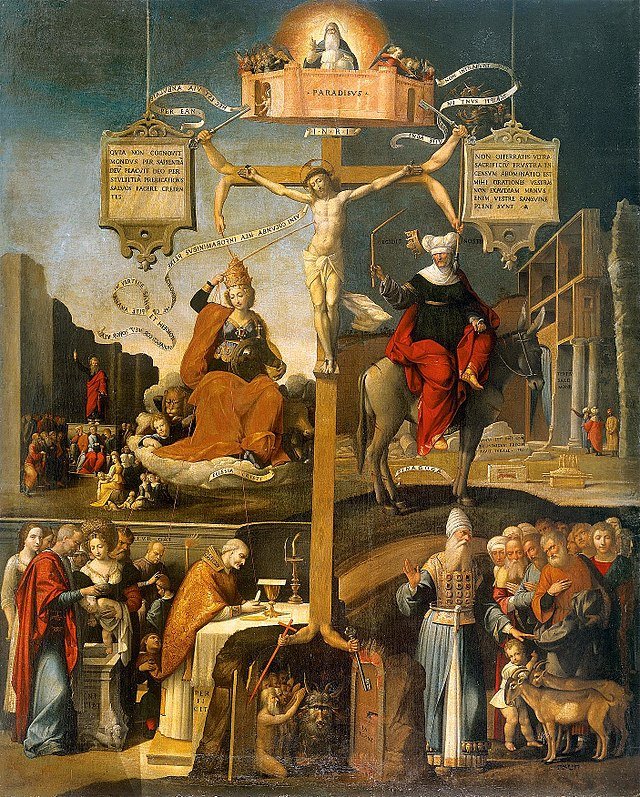
The idea that salvation is a family affair, rooted in the “Covenant.” Groups like some Presbyterians, Lutherans, and Catholics believe that just as Jewish babies were circumcised into the community of Israel, Christian babies are baptized into the Church. It’s not about the kid’s “choice,” but about God’s promise to the parents and community. To the gatekeepers, skipping this isn’t just a preference; it’s leaving your kid outside of Heaven.
2. Baptismal Regeneration (The “Water Works” Mechanic)
Plenty of debates and variation here. Different views hold that the act of baptism is more of a literal moment of salvation. Baptists seem to have their own unique debates. While some view it as a symbol of something that has already happened, others believe it’s the instrument God uses to wash away sin. St. Augustine argued centuries ago that this is the “visible form of invisible grace.” If you haven’t hit the water, the “mechanics” haven’t been triggered yet. It turns a sacrament into a plumbing problem that people use to tell you that you’re still dirty, regardless of your heart.
3. Baptism of the Holy Spirit (The “Second Blessing”)
Usually found in Pentecostal and Charismatic circles, this nuance suggests that getting “saved” (conversion) is just Phase One. As one example, the Christian & Missionary Alliance has one unique teaching that we are first saved from the guilt of sin and then, later, from the power of sin, and this is a Wesleyan idea of the “second working of grace.” Kind of like a delayed theological firmware upgrade.
This specific doctrine can be found in charismatic and Pentecostal circles, too, teaching that unless a person has a certain set of spiritual gifts, then they haven’t been saved. To be “fully” in, or at least “empowered,” you need a secondary experience, the Baptism of the Holy Spirit, often marked by speaking in tongues. It’s another way we find to look at someone else and say, “You’re missing a prerequisite to belong.”
Sit in enough churches, and you’ll hear them refer to others who aren’t true: “There are some good churches,” or “Some preach the full Gospel.” I’ve heard several variations. After enough time, a pattern emerges: there are plenty of fingers pointing out the door and windows, but very few pointing at the mirror.
“The New Testament is very simple. It is not a book which is to be interpreted… it is a book which is to be obeyed.”
— Søren Kierkegaard
Commandment Charcuterie Boards
During my first year of Bible college, an old professor told a student that she wasn’t saved because she hadn’t been baptized yet. The look on her face and awkward silence in the classroom are what I remember, as well as thinking it was BS. Later, a friend of mine became charismatic and accused me of depriving God’s people of the Spirit.

Jumping ahead, several months ago, an older gentleman I first met as a church planter in Missoula was at one of my favorite local spots, and we saw each other. I wasn’t excited, and here’s why:
When we had first met, he drilled me with Restoration theology and questions about the church we were trying to start. Then, he said he was disappointed in my theology. When I was first getting sober, he saw me again and went out of his way to tell me that a second time.
And, on that particular day, I was working on a book and knew he’d only be more disappointed. I wasn’t sure if I’d keep my cool with someone like him. So, I wasn’t all that thrilled, but there we were.
On the table were his Bible and notepad, while he descended into the Greek of the New Testament “commandments.” We exchanged back and forth a bit, and at one point, he said, “I’ve seen your Christianity before.” At which point, I had had enough, so I stopped holding back and let everything out that I was actually thinking. To summarize how it ended, he replied in a softer tone, “Maybe we aren’t as different as we thought.“
Yeah….in the Old Testament, there are 613 Commandments. In the New Testament, imperatives, exhortations, and directive statements are somewhere between about 800 and 1,050, depending on counting rules. Of those, there are about 59 “one-another” commands1.
In Jesus’ time, commandments were also a big topic, as were culture and politics. So, let’s talk about Christ’s commandments.
Some Red Letter Mandates
“Before the curtain comes down, we must somehow find the ‘true self’ that was hidden under the ‘false self’ we spent the first half of our lives building.”
— Richard Rohr
These aren’t the Ten Commandments. Christ’s commands cut through systems and get straight to the ontological point: What kind of person are you?

- Die to Self: Literally, it’s “deny himself.” The imagery of the Cross and following in Jesus’ steps makes it clear that dying to self, as Paul the Apostle clearly instructed and modeled in his epistles, was central to being a Christian. There’s a reason the self has to die for us to live. In today’s world, we all understand “ego,” and that it’s not just pride. Society is starting to wrestle with things like the shadow. As Carl Jung or Richard Rohr might frame it, the ego is a fake construct, a survival mechanism that eventually falls apart. Christianity has been teaching this “ego-death” long before we had the psychological vocabulary for it. To “deny” the self is to dismantle the false identity that keeps us from Reality. This is the “false self” that recovery teaches us to recognize—the persona we constructed to survive, which ultimately becomes the prison we die in.
- Let your “Yes” be “Yes” and “No” be “No”: Anything else is of the enemy. This is about radical integrity. It cuts through the rationales, justifications, hypocrisy, and broken promises. Dallas Willard points out in The Divine Conspiracy that this command is about the transparency of the heart—when you stop trying to manipulate others with your words, you start living in the Kingdom. In recovery, we learn this the hard way: every time we say “I’ll quit tomorrow,” every rationalization, empty promise, and half-truth is another brick in the wall between us and reality. Jesus is commanding a level of honesty that some of us can’t comprehend until we’ve bounced off rock bottom.
- Forgive as you are forgiven: The Lord’s Prayer and other places make forgiveness a command; it’s almost a prerequisite for experiencing God’s forgiveness. We can’t accept grace when we are full of resentment. This is something AA has taught me: Resentment is the “number one offender.” It blocks us from the sunlight of the Spirit. Whether it’s “Turn the other cheek,” “Father forgive them,” or “Forgive as you’ve been forgiven,” it’s the same mechanic. AA’s Fourth Step inventory and the Ninth Step amends aren’t optional add-ons to spiritual life—they’re the doorway through which grace actually enters. How can we accept God’s unconditional forgiveness if we hold onto unforgiveness and resentments? Will we trust God with those, or will we place ourselves in His role?
- “Be Reconciled” (Matthew 5:23-24): Jesus commands that if we’re at the altar and remember a brother has something against us, we leave. We fix the human relationship before we try to offer anything to God. Don’t hide in our church services or busy lives. Don’t crawl into a hole or dig trenches, alcoholic and avoidant ones included. The horizontal fix is required for the vertical connection. Our worship, prayers, and Bible study—all of it is for the purpose of making us into the people God can use to bless, heal, and love this world through. That includes amends, making things right with the person you’ve wronged. We’d often crucify each other from a distance instead of resolving the conflict. Seen in this light, church attendance could be mark of sin, not salvation. How many church splits, families destroyed, and relationships sacrificed on the altar of “being right” could have been prevented if we took this command seriously?
- Serve the poor, broken, sinners, lost, etc.: “Do it to the least of these and you do it to me.” Why aren’t we sprinting with the tools, resources, and numbers we have to do more than temporary fixes and little campaigns that make us feel and look good? Gustavo Gutiérrez, a Peruvian theologian, calls the “preferential option for the poor“—not a suggestion, but a foundational logic of the Gospel. When the American church argues about worship styles and theological minutiae while 140 million Americans live in or near poverty, loneliness, mental health burdens, or addiction, and when we build million-dollar buildings but can’t get along long enough to actually help the poor, broken, and lost people in our neighborhoods, we’re not just missing the point—the explicit words of Christ were already inverted when they were handed to us
- Love God and Your Neighbor as yourself: It’s just like loving God (c.f. John 17 and 1 John). There are three commands here to pull off what Jesus said the whole Law was about: Loving God, Loving our neighbor (based on proximity and not preference), and Loving Self. Jesus took this one thing and changed it when He taught His one “new” commandment by saying we ought to love one another as He loved us, and he taught that after washing people’s feet and Judas had left to betray them. Paul the Apostle will say in Galatians that the whole Law hangs on the one word of agape love. You will need to love yourself to obey and become more like Christ.
If you can’t love the image of God in the person in front of you, the rest is just noise. René Girard would say we’ve become trapped in “mimetic rivalry”—we define ourselves against our neighbors rather than for them. We hate before we even speak, polarized by algorithms that profit from our division. But Christ’s command demolishes this: the neighbor you despise, political opponent you demonize, addict you judge, and immigrant you fear—they bear the image of God, and your ability to love them is the measure of your love for God.
- “Judge Not” (Matthew 7:1): This isn’t just about being “nice.” It’s a command to stop the habitual act of placing yourself in the seat of God (c.f. Genesis 50:19-20). In recovery, we know that looking at someone else’s “inventory” is a sure way to ignore our own. When American Christianity spends more energy condemning the sins of others than examining the logs in its own eye, we’re not just being hypocritical. We’re violating a direct command of Christ. The evangelical obsession with other people’s sin while tolerating greed, gossip, apathy, and judgment in the pews isn’t theology—it’s Pharisaical pathology.
- “Do Not Be Anxious” (Matthew 6:25-34): This is a command to reject the “scarcity mindset.” It’s a command of acceptance and letting go of things we can’t control. Jesus is commanding a radical trust in the underlying goodness of God’s provision and sovereignty—a direct challenge to the greed that drives our economy. When Christendom accumulates wealth while their neighbors starve, when we hoard resources out of fear while claiming to trust God, when we build bigger barns instead of bigger tables—we’re not just making poor financial decisions. We’re disobeying a direct command of Christ. The prosperity gospel didn’t invent American Christian greed; it just baptized what was already there.
- BONUS—Paul’s commandment about lawsuits to the Corinthians (1 Cor 6:1-8): The Apostle Paul asked a question that still makes us uncomfortable: Why are you taking your brothers and sisters to secular courts? Why are you airing the church’s disputes before unbelievers? He goes so far as to say it would be better to be wronged, to be defrauded, than to sue a fellow Christian (1 Cor. 6:1–8). That command runs directly against the grain of American Christianity, which increasingly relies on lawyers, courts, NDAs, and quiet settlements to manage conflict. Churches sue churches over property, slander, and rights. Christian families threaten litigation to force outcomes.
Abuse cases can be buried behind confidentiality agreements “for the good of the witness.” Everything gets handled behind closed doors, while public language about forgiveness and reconciliation remains safely abstract. Paul’s point cuts deeper than legality: the way we handle conflict exposes which kingdom we actually trust. When the courts become our default peacemakers, when justice is outsourced to contracts and threats rather than repentance and repair, we’re not protecting the church’s witness—we’re confessing that earthly power feels more reliable than resurrection-shaped reconciliation.
“God is not found in the soul by adding anything, but by a process of subtraction.”
— Meister Eckhart
What is really going on?
“The Church exists for nothing else but to draw men into Christ, to make them little Christs. If they are not doing that, all the cathedrals, clergy, missions, sermons, even the Bible itself, are simply a waste of time.”
— C.S. Lewis

The debates we’re having aren’t primarily about theology—they’re about power, control, ego, and the disintegration of the structures that used to hold us together.
- Sexuality: Usually boils down to monogamy, sex outside of marriage, LGBTQ+, pornography, and, also, the nature of marriage (the submission of husband and wife; complementarianism or egalitarian, for example). This is not just about “rules”—it’s about the ontology of how we relate to one another. When 50% of marriages end in divorce (including Christian marriages), when pornography addiction silently lingers on men and women in churches, when abuse scandals reveal systemic cover-ups—maybe the problem isn’t that we don’t have enough rules. Maybe the problem is we’ve reduced sexuality to rules instead of addressing the deeper brokenness in how we relate to ourselves, others, and our bodies. The purity culture of the ’90s and 2000s didn’t produce holiness—it produced shame, trauma, and a generation walking away from the church. We tried to fix a heart problem with another checklist.
- Family: Remember the word “blended” family. What is America now? Families are hurting and fractured, stretched and broken, and we can exist in bubbles and pocket universes disconnected from other pockets we inhabit. The world is busy, distracting, and overwhelming—and families are trying to keep up. The nuclear family that mid-century evangelicalism idolized was a brief historical anomaly, not a biblical mandate. Extended families, multi-generational households, and communal child-rearing are far more consistent with Scripture and human history than the isolated suburban household. But we’ve turned “family values” into a weapon against single parents, divorced people, and anyone whose family doesn’t look like the Cleaver household—ignoring that Jesus Himself redefined family around Kingdom belonging rather than bloodline. We’ve traded “Covenantal Community” for isolated comfort. We aren’t just bubbles; we’re well-guarded silos
- Economy: Just going to list and trust we all get it enough, no matter what side you vote on. Wealth inequality is at levels not seen since the Gilded Age. Christians are defending billionaires while opposing minimum wage increases. Megachurch pastors flying private jets while their congregants can’t afford medical care. Theological defenses of prosperity, while Jesus had nowhere to lay His head. The conflation of capitalism with Christianity, as if the free market is the Kingdom of God. When the early church in Acts practiced radical economic sharing, “no one claimed that any of their possessions was their own,” they weren’t being communist. They were being Christian. Our refusal to even consider these challenges the fundamental assumptions that make our lifestyle possible. We worship a God who had nowhere to lay His head, while we vote for policies that protect our way of life.
- Neighbors: We have lost the ability to have neighbors and friends across the aisle. We hate each other before we even go out our doors. As René Girard argued, we are caught in “mimetic strife”—we hate each other because we’ve become mirrors of each other’s outrages rather than followers of the One who broke that cycle. Social media has weaponized our tribal instincts. Cable news has monetized our outrage. Political parties have baptized our hatred as righteousness. And the church, instead of being a prophetic alternative, has become the loudest cheerleader for division. When Christians can’t share a meal with someone who voted differently, when we unfriend family members over political posts, when we demonize half the country as enemies of God—we’re not being faithful. We’re being Pharisees.
Yes, politics matter, but it’s downstream from culture. And America’s politics is a big ole circus. We’re trying to do the same things over and over again, it’s getting worse, and the temptation to bury our heads in the sand is also easier to maintain than change.
When it comes to Biblical commandments, or politics, the telos of all of them is love.
A Different Direction
“Love—and the unity it creates—is the final apologetic. It is the only thing the world has a right to use as a test of whether we are truly followers of Christ.”
— Francis Schaeffer
Love is the greatest command. Doing it truthfully is a lifelong journey. Some, like me, get started on it a little late in life.

This doesn’t answer all the questions, but it does change directions: it changes the questions we ask and the way we do things, from bottom up, top down, and sideways, even across the political aisles. It might be the only solution now.
What if we spent as much energy following Christ’s explicit commands as we spend debating interpretations of Romans? What if sermons focused on the words in red, the actual mandates from Jesus, instead of culture war talking points? What if we took “die to self” as seriously as we take “no sex before marriage”? What if forgiveness, reconciliation, love of enemy, and service to the poor became the litmus tests for Christian orthodoxy instead of positions on secondary issues?
Maybe if we actually obeyed the commands we have, we’d spend less time arguing about the ones we don’t.
The trajectory of American Christianity is unsustainable. We’re hemorrhaging young people who see the hypocrisy and oncoming train of the future we’ve made for them. We’re losing credibility with a watching world that sees us defend our power while ignoring the suffering of the world. We’re fragmenting into ever-smaller tribes, each convinced they uniquely have the truth. But Jesus gave us a different way—a narrow way, yes, but one marked by clear commands that leave little room for interpretation.
Die to self. Grow up. Be honest and trustworthy. Forgive relentlessly. Serve others. Love your neighbor. Don’t judge. Be reconciled. Trust God. Be fully alive.
For 2026, these are some “resolutions” on my mind to become more like.
What are yours?
“The mission of the church is to be a sign and a foretaste of the kingdom of God… not to be a pressure group for a particular political agenda.”
— N.T. Wright
Footnotes
- Be at peace with one another. (Mark 9:50)
Wash one another’s feet. (John 13:14)
Love one another. (John 13:34)
Love one another. (John 13:34 — repeated instance)
Love one another. (John 13:35)
Love one another. (John 15:12)
Love one another. (John 15:17)
Love one another with brotherly affection. (Romans 12:10)
Outdo one another in showing honor. (Romans 12:10)
Live in harmony with one another. (Romans 12:16)
Owe no one anything, except to love one another (implicit in Romans 13:8)
Do not pass judgment on one another. (Romans 14:13)
Welcome one another as Christ welcomed you. (Romans 15:7)
Instruct one another. (Romans 15:14)
Greet one another with a holy kiss. (Romans 16:16)
When you eat together, wait for one another. (1 Cor 11:33)
Have the same concern for one another. (1 Cor 12:25)
Greet one another with a holy kiss. (1 Cor 16:20)
Greet one another with a holy kiss. (2 Cor 13:12)
Through love serve one another. (Galatians 5:13)
Don’t bite and devour one another. (Galatians 5:15)
Do not provoke or envy one another. (Galatians 5:26)
Bear one another’s burdens. (Galatians 6:2)
Be patient, bearing with one another in love. (Ephesians 4:2)
Be kind to one another. (Ephesians 4:32)
Forgive one another. (Ephesians 4:32)
Address one another in psalms, hymns, and spiritual songs. (Ephesians 5:19)
Submit to one another out of reverence for Christ. (Ephesians 5:21)
In humility, count others more significant than yourselves. (Philippians 2:3)
Do not lie to one another. (Colossians 3:9)
Bear with one another. (Colossians 3:13)
Forgive one another if one has a complaint against another. (Colossians 3:13)
Teach and admonish one another in all wisdom. (Colossians 3:16)
(Variant entry of teaching/admonishing) — same reference. (Colossians 3:16)
Abound in love for one another. (1 Thessalonians 3:12)
Love one another. (1 Thessalonians 4:9)
Encourage one another. (1 Thessalonians 4:18)
Encourage one another. (1 Thessalonians 5:11)
Build up one another. (1 Thessalonians 5:11)
Exhort one another every day. (Hebrews 3:13)
Stir up one another to love and good works. (Hebrews 10:24)
Encourage one another, especially as the day approaches. (Hebrews 10:25)
Do not speak evil against one another. (James 4:11)
Do not grumble against one another. (James 5:9)
Confess your sins to one another. (James 5:16)
Pray for one another. (James 5:16)
Have unity of mind, sympathy, brotherly love for one another. (1 Peter 3:8)
(Variant on unity/sympathy) — same reference. (1 Peter 3:8)
Love one another earnestly. (1 Peter 4:8)
Show hospitality to one another without grumbling. (1 Peter 4:9)
Use spiritual gifts to serve one another. (1 Peter 4:10)
Clothe yourselves with humility toward one another. (1 Peter 5:5)
Greet one another with the kiss of love. (1 Peter 5:14)
Love one another. (1 John 3:11)
Love one another. (1 John 3:23)
Love one another. (1 John 4:7)
Love one another. (1 John 4:11)
Love one another. (1 John 4:12)
Love one another. (2 John 5) ↩︎