Table of Contents Show
“The sequence of days in John 1… is a deliberate reconstruction of the creative week of Genesis 1.”
— N.T. Wright, (John for Everyone)
In the previous post on John, we barely touched on John the Baptist and the group of seven (heptad) titles John wove into the first chapter. We didn’t discuss much of what the Gospel said about the Baptist, and skipped a lot among the titles.
We’ve discussed how “belief” is not a good translation: “Trust” or “to be faithful” is accurate, but an intellectual agreement can be easily faked or forced1. Faith will be another important word for John’s Gospel. It uses the verb pisteuō (“to trust”) around 98–99 times, while the noun, pistis, is rare. Faith is something we do, not “believe.” Faith is how we become the things we say we believe, do the things we say we want to, and stop doing the things we can’t seem to stop. Faith is how humans change for good.
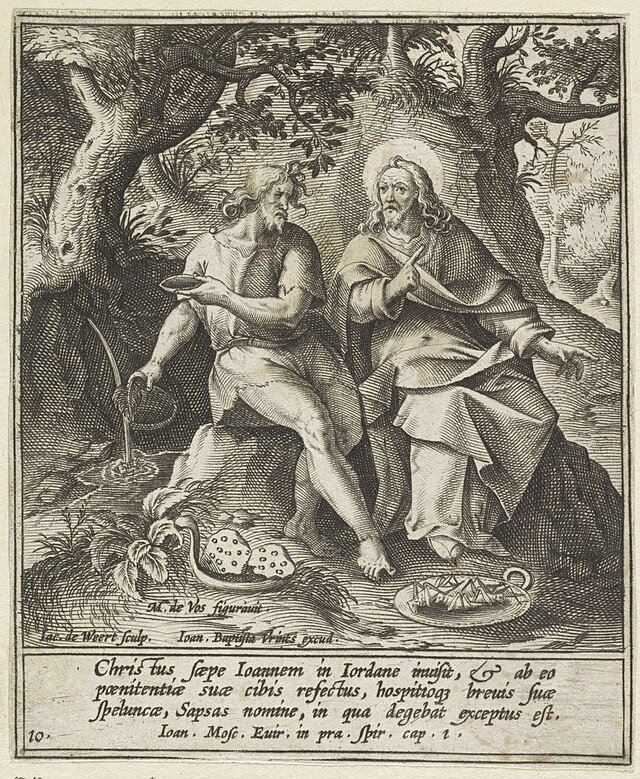
John the Baptist
John the Baptist’s death is not directly described in John’s Gospel, like in the Synoptic Gospels (Matthew, Mark, Luke). Later, his imprisonment is implied parenthetically in John 3:24, “(for John had not yet been put in prison).” A few verses later, the Baptist subtly foreshadows his death, silent in John’s Gospel, with his own words, “He must increase, but I must decrease” (v.30). John the Baptist disappears from the narrative after chapter 3.
John’s Gospel clearly assumed his audience had some familiarity with the other Gospels since Christianity had spread and grown. John uses the Baptist’s legacy to begin the actual plot: Who is the Christ?
John the Baptist is canon in the Synoptics and often associated with Elijah. In fact, Matthew dressed the Baptist in the same costume as Elijah, wearing “clothes made from camel’s hair and had a leather belt around his waist” (Matthew 3:4)2. And later Matthew will say John the Baptist was Elijah (Matthew 11:14; 17:12-13). But here, John’s Gospel does the opposite, skips most of the story, and starts with a deeper truth and poses the question, “Who is the Christ?” which he had apparently already answered in verse 17 (“grace and truth came through Jesus Christ”). John the Baptist most definitely played an Elijah-like role in an Elijah-like archetypal way. And he was only John the Baptist.
7 Titles & 7 Days (John 1-2:1)
Using John the Baptist as an introduction also sets up the first title of Jesus, as we ended the last post with, but here they are again:
- The Word (Logos): John 1:1-3
- The Light: John 1:4-9
- The Lamb of God: John 1:29, 36
- The Son of God: John 1:34, 49
- The Messiah (Christ): John 1:41
- The King of Israel: John 1:49
- The Son of Man: John 1:51
Each of these will come later in the Gospel. Here, in chapter 1, they’re merely introductory and just part of the plot. Starting with the Pharisees and John the Baptist, the Gospel of John rapid fires a seven-day week:
- Day 1 (1:19-28): John the Baptist testifies to the priests and Levites that he is not the Messiah.
- Day 2 (1:29-34): “The next day,” John sees Jesus and declares Him the “Lamb of God.“
- Day 3 (1:35-42): “The next day,” John’s disciples (Andrew and likely John) begin to follow Jesus; Andrew brings Peter.
- Day 4 (1:43-51): “The next day,” Jesus calls Philip, who then brings Nathanael.
- Days 5 & 6: Implied span of travel or preparation, as the narrative shifts to the wedding in chapter 2.
- Day 7 (2:1): “On the third day” (from Day 4), Jesus performs his first sign of turning water into wine, at a wedding in Cana.
It is subtle, and scholars generally agree intentional. Brilliant too. Creation was more than hinted at in verse 1; it was reopened for discussion, and already John has used a seven-day Creation week to frame Jesus with seven titles that also ought to reframe human anthropology. NBD.
“The Logos, the now-risen Son of man, is currently preparing for us to join him.”
— Dallas Willard
Day Two Of A Baptist’s Testimony (John 1:29-31)
The next day he saw Jesus coming toward him, and said, “Behold, the Lamb of God, who takes away the sin of the world!This is he of whom I said, ‘After me comes a man who ranks before me, because he was before me.’I myself did not know him, but for this purpose I came baptizing with water, that he might be revealed to Israel.”
John the Baptist first identifies the “Christ” as the Lamb who takes away the sin of the world. The rest of this Gospel will be how Jesus does that. Interestingly, Joachim Jeremias, a German Lutheran theologian (1900–1979), points out that “in Aramaic, talya can mean both ‘lamb’ and ‘servant,’ potentially linking the Lamb of God to the Suffering Servant of Isaiah.” John uses amnos for ‘lamb’ here (sacrificial); the imagery of the arnion that dominates Revelation is a different strand of Johannine symbolism. This is just one of John’s “bookends,” also called inclusiones (singular, inclusio)3, that he’ll use to “initiate” readers of the Gospel into the mysteries contained behind the veil.
Outside of John’s writings, amnos only appears two other places in the entire New Testament (Acts 8:32 and 1 Peter 1:19), both specifically referring to a lamb being led to slaughter.
When asked who he was, the Baptist simply replied with Scripture: “I am the voice of one crying out in the wilderness, ‘Make straight the way of the Lord,’ as the prophet Isaiah said.”
Whenever Scripture refers to itself, even in jest, it matters. And here, it’s worth reading some of the context around what the Isaiah passage the Baptist cited. Worth remembering, as well, is that Israel was in Babylonian captivity when Isaiah was a prophet:
“Comfort, comfort my people,” says your God.
— Isaiah 40:1-5
Speak tenderly to Jerusalem,
and cry to her
that her warfare is ended,
that her iniquity is pardoned,
that she has received from the Lord’s hand
double for all her sins.
A voice cries:
“In the wilderness prepare the way of the Lord;
make straight in the desert a highway for our God.
Every valley shall be lifted up,
and every mountain and hill be made low;
the uneven ground shall become level,
and the rough places a plain.
And the glory of the Lord shall be revealed,
and all flesh shall see it together,
for the mouth of the Lord has spoken.”
For the Baptist, citing Isaiah was a Biblical backhand to self-righteous Pharisees. The Pharisees weren’t all excited about a random dude baptizing people, since they already had a perfectly good and religiously pure mikveh system. In response, the Baptist states that he was only baptizing with water, and seems to imply that whoever is coming next would baptize with something more. And, just to hint at what that is, John includes another juicy biblical detail.
Elijah & John The Baptist
“These things took place in Bethany across the Jordan, where John was baptizing” (v. 28). While the Baptist specifically stated he was not Elijah, here the Baptist is precisely located where Elijah was, as well as a few other places. Narratively and Scripturally, the Pharisees’ question also exposes them as more in line with the prophets of Baal and Jezebel than with the Spirit of God.
One of the things John is hinting at here is that the “double portion” of the Spirit that Elisha got would be coming through Jesus (i.e., the Holy Spirit was about to be unleashed on the whole world). John may also be hinting at the birth of a hybrid creation and nation.
Day two of John’s creation week was the third title for Jesus (“Lamb of God“), and where John, the writer, included a past tense testimony of the Baptist about Jesus’ baptism, instead of actually just recounting the events. Then, the Gospel writer uses the end of the second day to have the Baptist also tell us the fourth title for Jesus, “son of God”: Caesar’s favorite title and center of John’s seven titles.
And John bore witness: “I saw the Spirit descend from heaven like a dove, and it remained on him. I myself did not know him, but he who sent me to baptize with water said to me, ‘He on whom you see the Spirit descend and remain, this is he who baptizes with the Holy Spirit.’ And I have seen and have borne witness that this is the Son of God.”
— John 1:32-34
Every Gospel includes Jesus’ baptism. In the Synoptics, Jesus will say it was necessary for the sake of righteousness, implying both for the sake of goodness, as well as authentic leadership and identification with Israel: John the Baptist & Jesus are a pair. It was important that the role and relationship of Jesus’ person submitted and surrendered to the process, to become it. Even Jesus wasn’t self-appointed (like Elijah).
On Baptism As An Initiation
John opened his Gospel with Genesis, and respects the relational lineage of John the Baptist and Jesus. I’ve heard it suggested that the Baptist may have discipled Jesus, and after doing some work with Elijah and Elisha, it’s a lot more plausible to me. I think, in part, this is also what Jesus meant by it being necessary for “righteousness.” It was good, it was relational, it was needed to make sure Jesus’ thing was not just Jesus’ thing. Jesus had to be it, and he did it with joy.
The baptism of Jesus in all four Gospels calls the reader back to the opening pages of Creation, where the Spirit “hovered” over the water. In Hebrew, it’s merahephet, meaning “fluttered” like a bird. Note that John the Evangelist never actually describes the baptism. He only describes John the Baptist testifying to the Spirit remaining. The focus is entirely on the permanent descent of the Dove, echoing the Spirit hovering over the waters in Genesis 1:2.
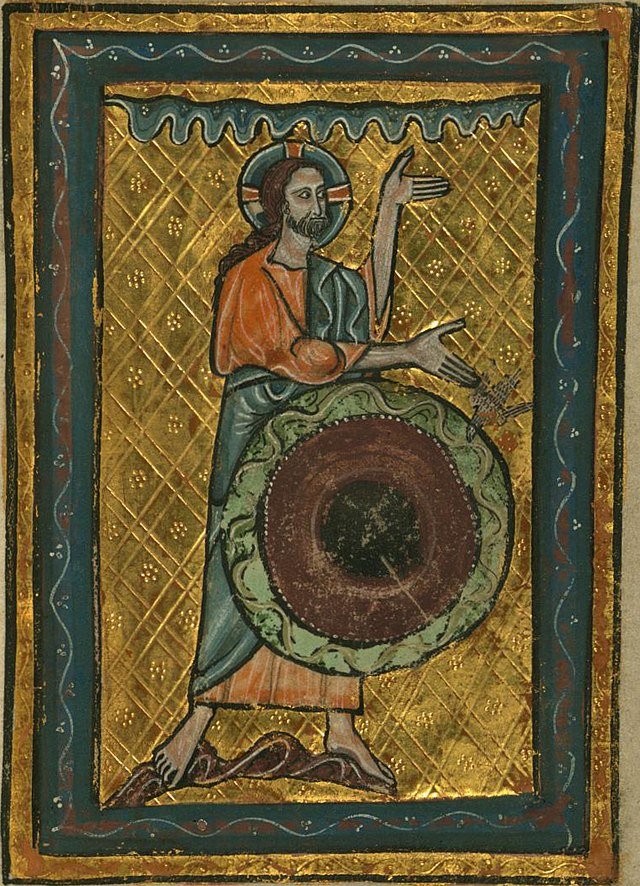
C.K. Barrett, a British New Testament scholar (1917–2011), noted that “the Spirit ‘remained’ (emeinen) on him. This permanent endowment distinguishes Jesus from the temporary inspiration of the prophets.“
Baptism, far from being just an external “sign” of inward change, is meant to initiate and be a tool for the death of the ego (or false self) and rebirth of the true self. It takes us into the abyss and awakens us into His life and newness. Of course, this is not a one-and-done thing, nor an overnight thing. It was a significant initiation, though, the kind of thing you couldn’t go back from. It’s sort of like saying, “Hello, I’m _____, and an alcoholic” for the first time when you’ve been avoiding it for way too long.
It’s telling that Jesus also fasted for 40 days. Fasting can help break a person of attachments and excess, of needs and addictions. It used to be a common tool in spiritual transformation for ancient people, and is still a biblical command, as are meditation, discipline, study, prayer, confession, and community. Baptism would not have been a commodity or performance: it was a surrender of control and masks. It was an initiation that broke a person so they could be something else. It still is.
Of course, John records that there was going to be a difference between the Jewish Mikvehs and the baptism Jesus would bring, one of fire and a double portion of the Spirit. While we don’t live in the first century and most of us are not Jewish, initiation and community are important, psychological realities that are sometimes either missing or abused. Both are used in manipulation, and in how we can avoid a therapist like the plague. It can be why we fall back to old assumptions and ways, because they’re more comfortable than the devil we don’t know.
The baptism Jesus brought was something different and not: it was Genesis for the whole world. The early church practiced baptism, the physical act, as one of its rituals, a ceremonial tool to initiate a person into the community. It was not something we did, but was done to us. It formed a trusting bond and stood as a symbol of being part of a community that was distinct from the world. And, boy, had it better be “an outward expression of an inward change,” as it is the genesis of spiritual transformation and a different way of living.4
The Third Day, Jesus Calls the First Disciples (John 1:37-42)
The two disciples heard him say this, and they followed Jesus. Jesus turned and saw them following and said to them, “What are you seeking?” And they said to him, “Rabbi” (which means Teacher), “where are you staying?” He said to them, “Come and you will see.” So they came and saw where he was staying, and they stayed with him that day, for it was about the tenth hour.
v. 37-39
In Israel time, this is about 4:00 PM. It’s also literally “10,” so there’s a scholarly debate on the exact time. For John, it’s still the “tenth” hour, and 10 implies community and is a number used in the linguistic structure of Genesis 1-2:3, hinting at the 10 commandments and a covenant relationship with the Divine. It explains why they stayed the night, since it was too late to travel. It marks the shift from a casual inquiry to “abiding” (meno), a core Johannine theme. As B.F. Westcott, a British bishop and Cambridge scholar (1825–1901), points out, “the specification of the ‘tenth hour’ is the reminiscence of an eyewitness… for whom the moment was etched forever.”
Simon & Not Yet Peter
One of the two who heard John speak and followed Jesus was Andrew, Simon Peter’s brother. He first found his own brother Simon and said to him, “We have found the Messiah” (which means Christ). He brought him to Jesus. Jesus looked at him and said, “You are Simon the son of John. You shall be called Cephas” (which means Peter).
v. 40-42
Jesus, when he met Simon, did not change his name immediately. John prophesied the name change, whereas the Synoptics record the moment Simon becomes Peter. Matthew’s Gospel recounts the moment Simon’s name changed on a field trip to the Greco-Roman “district of Caesarea Philippi,” where Simon suddenly realized Jesus was “the Christ, the son of the living God” (Matthew 16:18). But that wasn’t this moment, when they first met. It’s telling that Simon’s transformation takes time, that he must journey with Jesus to learn what he had to have his epiphany away from his Jewish context.5
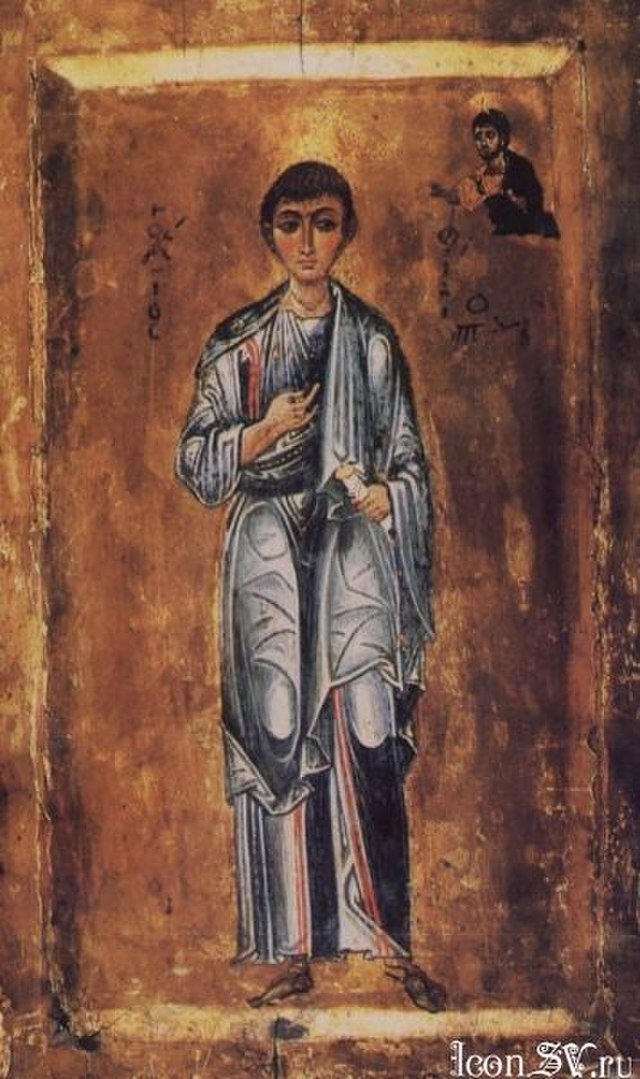
The Fourth Day – Jesus Calls Philip and Nathanael
The next day Jesus decided to go to Galilee. He found Philip and said to him, “Follow me.” Now Philip was from Bethsaida, the city of Andrew and Peter. Philip found Nathanael and said to him, “We have found him of whom Moses in the Law and also the prophets wrote, Jesus of Nazareth, the son of Joseph.” Nathanael said to him, “Can anything good come out of Nazareth?” Philip said to him, “Come and see.” Jesus saw Nathanael coming toward him and said of him, “Behold, an Israelite indeed, in whom there is no deceit!” Nathanael said to him, “How do you know me?” Jesus answered him, “Before Philip called you, when you were under the fig tree, I saw you.” Nathanael answered him, “Rabbi, you are the Son of God! You are the King of Israel!” Jesus answered him, “Because I said to you, ‘I saw you under the fig tree,’ do you believe? You will see greater things than these.” And he said to him, “Truly, truly, I say to you, you will see heaven opened, and the angels of God ascending and descending on the Son of Man.”
v. 43-51
Jesus calls Nathanael a man in whom there is “no deceit” (dolos). This is a direct callback to Jacob, whose name and reputation were defined by deceit. Jesus is identifying Nathanael as a “True Israel” of the patriarch without guile. In Rabbinic literature, “sitting under the fig tree” was a common idiom for meditating on the Torah, explaining why Nathanael was impressed that Jesus “saw” him.
A lot of details that we are glossing over for the sake of getting to the meat of John’s Gospel, however, Nathanael’s calling completes all but the final of Jesus’ titles. Nathanael’s title, what he was looking for, was a “King of Israel,” and that was politically charged. In response, Jesus, instead of denying the title, said the last and final title Himself: “the son of man.” Kosmos refers to the entire created order and its systems, not just individual people. Rudolf Bultmann observed, “Nathanael’s confession ‘King of Israel’ is politically charged, which Jesus reorients toward a cosmic vision.“
But Jesus doesn’t repeat it. He tells Nathanael that as a result of trusting to follow Him, Nathanael “will see heaven opened, and the angels of God ascending and descending on the Son of Man.”
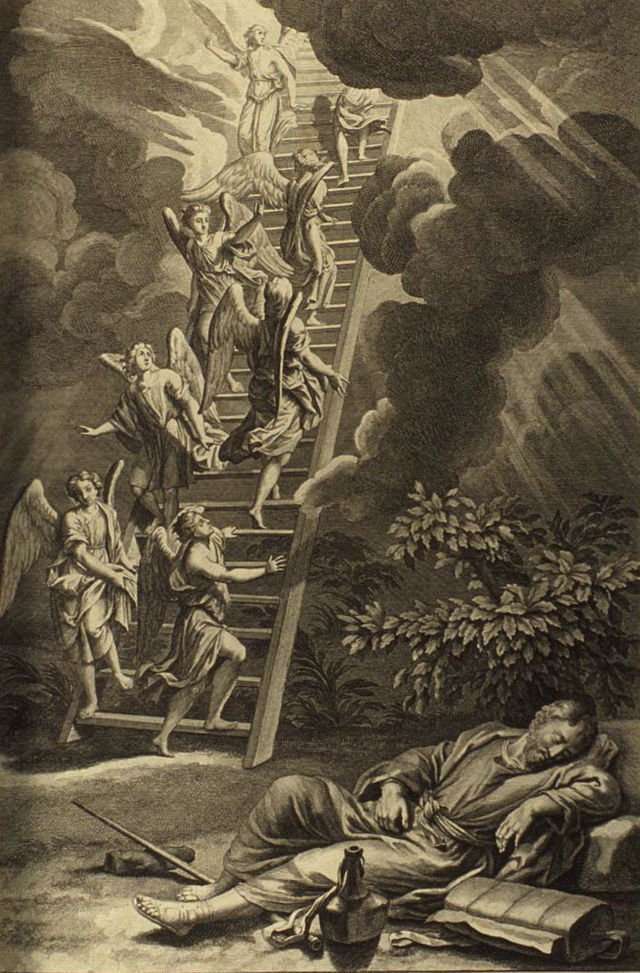
“The title ‘Son of Man’ draws together the figure of Daniel 7 and the human figure who connects heaven and earth.”
— Herman Ridderbos, The Gospel of John
This is a direct reference to Jacob’s vision, which he had when he was fleeing his brother and homeland, and sleeping on a rock. Yet another child running away to a distant land who didn’t realize God was always right there. The Bible is the same story from beginning (genesis) to end (telos).
In Genesis 28:12, Jacob’s dream describes “angels of God ascending and descending” on the ladder set between earth and heaven. Several commentators note that John’s Greek allows the symbolism to be reinterpreted christologically: the point of contact between heaven and earth is no longer a place (Bethel) or a structure (a ladder), but a person. The angels are described as ascending and descending upon the Son of Man, indicating that Jesus himself has become the locus of divine-human communion. As C. H. Dodd observed, this imagery signals a shift from sacred geography to personal mediation, while Raymond Brown argues that Jacob’s ladder is reimagined christologically, with the Son of Man as the new “meeting place” of revelation. The promise that Nathanael “will see” this vision only as he follows further reflects Johannine epistemology, in which perception flows from participation rather than detached observation.
Craig Keener also said, “By invoking the ladder of Jacob, Jesus presents himself as the new Bethel—the locus of divine visitation.” Scripturally, logically, it’s more dangerous than that: the “son of man” title was never exclusive to Jesus and has a double-meaning. It’s a term for humanity, not divinity.
Jesus invited us to have what He had, to become as He was ourselves, that we would let those angels ascend and descend on us, the “sons of man,” that the Spirit would remain on us, that we would be sent as He was, and do even more than He did.
To Be Continued: John 2
In all earnest, I wanted to thoroughly cover the wedding feast in Cana, as it is not only the first thing that happens after Jesus’ name drop, but also is the final day of John’s Creation week and Jesus’ first of seven signs. While the first chapter is fast-paced and fully packed, John is going to slow down and start including us in more of the narrative.
We’ll pick up with John 2:1 and following for next time.
*Footnotes (& Leftovers)
- Extensive evidence from psychology, law, economics, and communication studies demonstrates that intellectual assent can be produced without genuine trust or fidelity. Research on coerced and false confessions consistently shows that individuals routinely affirm propositions they do not believe, particularly under conditions of pressure, authority, fatigue, or incentive; in such cases, assent functions as compliance rather than conviction. Social psychology also confirms agreement can be elicited through authority and situational control without internal commitment (e.g., the obedience experiments of Stanley Milgram). In behavioral economics and negotiation theory, verbal agreement in contracts and business dealings is often strategic (shaped by asymmetric power, risk calculation, or short-term gain) and does not reliably indicate trust or long-term fidelity (cf. Thinking, Fast and Slow by Daniel Kahneman, and The Master and the Emissary by Iain McGilchrist). Marketing and propaganda research further distinguishes between stated belief and durable loyalty, demonstrating that affirmation can be manufactured through framing, repetition, and social pressure without corresponding behavioral allegiance. Translating pisteuō as “belief” has been misleading: cognitive agreement is easily engineered, whereas trust and faithfulness require embodied participation and relational risk. ↩︎
- Matthew continues to say the Baptists’ “diet consisted of locusts and wild honey,” while Elijah was fed by ravens with bread and meat. The Nazirite vow (Numbers 6) allowed the consumption of locusts. According to biblical law, locusts are considered a clean, kosher food (Leviticus 11:22). The Nazirite restrictions, such as abstaining from wine/grape products, uncut hair, and avoiding dead bodies, didn’t prohibit eating permissible insects. John the Baptist, a Nazirite, was both standing in the role of Elijah and marking himself as something else, just as Jesus will step into Elisha’s role but as something else. History doesn’t repeat itself, but it rhymes. ↩︎
- An inclusio is a literary “bookend.” It’s a technique where an author starts and ends a section with the same word, theme, or idea. Everything inside these two points belongs together. Inclusios are like a bracket or the bread of a sandwich. ↩︎
- The baptism of Jesus seems to hold significant weight, similar to the Transfiguration, in that something significant happened for both John the Baptist and Jesus. There’s enough evidence to suggest Jesus and John the Baptist had Essene influences, while also enough to distinguish them: I’d suggest all three were distinct, and that, given some of the other research, “baptism” was not for them what it has become for us. ↩︎
- There is a psychological brilliance in how the name Simon persists throughout the story. The name comes from the Hebrew Shimon, meaning “to hear” or “to listen.” Even after Jesus gives him the new name Cephas (Peter/Rock), the Gospel writers, especially John, revert to calling him “Simon” whenever he’s acting out of his old nature.
For example, in the Garden of Gethsemane, when he falls asleep instead of praying, Jesus asks, “Simon, are you asleep?” (Mark 14:37). Most tellingly, in the final chapter of this Gospel, Jesus asks him three times, “Simon, son of John, do you love me?” It’s as if “the Rock” had crumbled under the weight of his denial, and Jesus had to meet the one who needed to listen again. ↩︎