Actively Under Development: Last updated on 6/21/2026
A Crash Course In (& Case For) Christian Mysticism
This is not a deconstruction, rather a reconstruction: Descending is a part of ascending.
I unknowingly stumbled into Christian Mysticism when my old structures of performative religion, false ego, manipulative patterns, and Western rationalism finally began failing. There were no more places to hide behind.
If you’re here, it might be because you’re wrestling with what you were taught (and maybe teach). What was certain became something else, and you dared to start wondering and questioning. Maybe what you once preached stopped matching with Reality and who you are, and wrestling with God is keeping you up at night.
Christian Mysticism is not a new set of rules. It’s an old truth in new times. Deconstruction and Reconstruction are processes, not simple categories to be debated. This section is an attempt to recover a historical and functional Christian Path: a process of ego-death, perceptual recalibration, honesty, relational community, and integration into the “All in All.” Mysticism is a human universal, catholic in personal implications. It’s the language without words that makes translation possible
Please, do your own research and study. These pages are the collection of more than two years of trying to put everyting I was once proud to know back together into something that might help others. It’s also a work in progress, an ongoing “experiment.”
My knee bent again to Jesus on Easter of 2024, and this is what I have found since.
An Entryway:
If you’re not sure what to make of mysticism, or how Christian mysticism differs from other traditions, start with something simple. These 21 “bullets” points look past modern fractures with testable logic as an attempt to accurately frame Scripture, Salvation, and the Second Coming. We are in another Ad Fontes (Back to the Sources) moment.
The TLDR, boiled down to a singular thesis, is that “son of man” is a title for humanity, not exclusive, isolated divinity. For “chapter and verse,” read every time Ezekiel is called a “son of man.” Pull on that exegetical thread, and be careful what unravels on your side of existence.
Biblical Exegesis: Framing the Narrative
The Bible was written to be read and heard by common people, not by elites. It was never meant to be a “confusing” book, and it’s a shame that it is. Anyone, especially today, can study Scripture authentically and with integrity. That’s just the challenge and also the blessing.
We don’t read the Bible to find rules; we read it to find ourselves and the God haunting us. By looking through the lens of original languages and historical context, the “Cover to Cover” story changes from divine retribution or a behavior modification manual to a map of resurrection.
Learn about Narrative Theology and explore a survey of the Bible.
Atonement & Eschatology: The End is the Beginning
In the Western tradition, these were about criminal justice and retribution, “Courtrooms” and “Fire.” In (Mystical) Christianity, they’re about Participation in Wholeness.
- The Cross: Not a payment to an angry God, but a Pattern of Ego-Death and Forgiveness that leads to Resurrection life.
- At-one-ment: The process of becoming whole (integration), where the fragmented self becomes “one” with Reality. This is on the ground level and within relationships. From the individual and community out, not hierarchy down.
- Eschatology: “Apocalypse” means unveiling, not the end. The “End of the World” is the Telos of ego and empires. The Second Coming is the Coming Capitulation of egoic assumptions and systems to the Ultimate Truth, especially Western.
Anthropology: The Human Design
To understand God, we must get past the “Mechanism” we are using to filter Reality (and scapegoat Him). We are Homo Participans: beings designed to participate in the divine nature.
The 5 Worlds: Navigating through the Infosphere and Noosphere so we can “Touch Grass” and talk again:
- The Inner World: The Subjective Conscious Holon and Awareness of the Collective.
- The Noosphere: Our Shared Heritage and Collective Story.
- The Lived World: Where Meaning Meets Contact, human to human within Creation.
- The Infosphere: The Digital Realm as an Ego–Shadow Extension.
- The World of Reality: The Empirical and Objective Domain, as if there were never any humans.
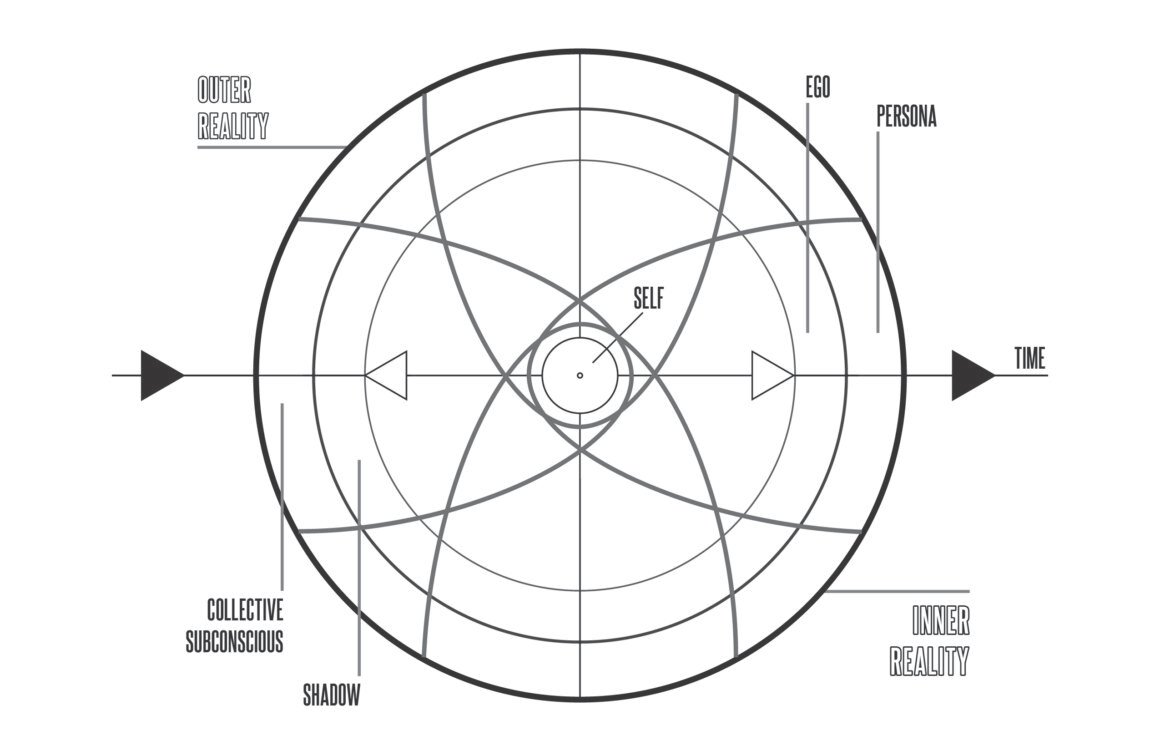
The Integration of Being: A conscious integration of the Body (feelings/cravings), Mind (intellect/creativity), Heart (empathy/emotions), and Soul (gut/pain/passion), so that the Self may be able to fully love God and neighbor as self.
Our Inner Compass: Love, Truth, Death, and Life are like four human compass points to navigate Reality with the self as the Arrow. The invitation is for us to finally allow both Spirit and Law into the heart of humanity.
Worship: Ego-Decentralizing, IFS, Communal Exposure, & Somatic Healing
Spirituality is not a forced performance, a passive checklist, an egoic defense, or a comforting escape hatch from reality. Real worship and prayer require the deliberate deflation of the ego and a willingness to do what it takes to become what God intends. What we are in worship, we ought to carry with us in the rest of life.
Somatic expression (i.e., bodily, which includes vocal) can bring our nervous system into functional alignment with the Divine while working through and out of subconscious baggage and life-giving realities. It is the practical surrender into a naked, present-tense relationship with reality while trusting God.
The physiological mechanics are personally objective, and thus subjective, tangible, and often experiential.
Spirit & Prophecy: Teleological Catalysts
Prophecy is not “fortune telling”; it’s Sanity. It is the ability to see past noise and charades, headlines, groupthink, and herd mentalities, and to speak the Telos that pulls people forward. It’s a gift that was promised in Amos for our sons and daughters. That time is on the horizon.
- Insight over Foresight: Seeing what others are blind to and being aware of what they are not. The wielder and how it’s wielded matter: character, composure, wisdom, love, and humility.
- The Practice: From ego-decentralizing worship and corporate meditation, to private prayer, baptism, communion, and “Spicy” rituals like fasting, IFS, tarot cards, and sweat lodges: these are tools to decentralize the ego and surrender control so the Divine may be God and not us.
- Magic & Practical Christian Practice: Magic has been called “spicy psychology,” and I don’t mind that. Faith is another good word for it. Just like with the Bible and anything else, prophecy and magic can be misunderstood and misused. However, “magic” is fundamentally human and inescapable. Where we live, here and now, is where miracles happen and the Divine meets us. Learning how to live life well is a real discipline.
Status: Also, actively in the lab.
Discipleship & Sanctification: Also Recovery & Mental Health
Laughably, I’m somewhat of a “subject matter expert” at the intersection of “Spiritual Malady” and Mental Health. Recovery is a return to sanity. And I found out that it was also the path of discipleship and sanctification. These paths provide a path to Reality and maturity, and ought to be healthy social norms, but are not. Therein lies the work.
The practical application of Mysticism helps people learn how to live in truth and love, and some Eastern principles are already standard in addiction and mental health, and are widely accepted by Christianity at large.
Over time, the plan is to develop some resources and tool kits. There’s a free 12-week peer-group curriculum that is a side project, which has also been a slow burn. It was designed to help people go inward, using some psychology, cognitive behavioral theory, and the Hero’s Journey. If it’s something that might help your people, check it out: www.everyhumansjourney.com.
Related Writings:
- Demythologizing Addiction: A recovering pastor’s guide to what addiction is.
- The 12 Steps for Everyone: A framework for the spiritual transformation (and repentance) approachable for anyone to understand in our modern world.