Table of Contents Show
“…the quietest means are the mightiest.”
— F.D. Maurice
Mt. Carmel felt like the pinnacle: fire from heaven, prophets of Baal were slaughtered, people confessed, and the drought ended.
However, it was hinting at the story’s weak seams. Part I dissected Elijah’s sudden appearance and dramatic deeds, where we left Elijah outrunning Ahab’s chariot.
As we saw, Biblical and rabbinic scholars alike have pointed out that Elijah took on a self-appointed calling without the humility Moses was known for (Numbers 12:3). Unlike other prophets, Elijah just appeared in Scripture without a commissioning. He was tenacious, boisterous, and maybe full of himself. Running in his own power, casually commanding droughts, people, and fire, Elijah’s plan seemed to work…sort of. It was hollow, short-lived, and Elijah had nothing left.
In 1 Kings 19, Scripture turns from Elijah’s public theater to God’s private pedagogy, or directed discipleship.

After the Fire: When Power Outruns the Prophet
If Mount Carmel dramatized what prophetic power at its flashiest, Mount Horeb stages the hard work of what follows when power outpaces wisdom and humility. Scripture arranges a sequence that initiates Elijah’s prophetic reframing: collapse → care → theophany → correction → commission.
Elijah’s mission was not off, but his heart and sight were. The problem was never merely a public enemy or the political failure of a leader. The problem has always been people: humans acting as though they had no problems of their own while attempting to rule over everyone else’s, exaggerating others’ sins while minimizing their own for the sake of feeling heroic, publicly crucifying another without justice or love. The problem always lies in the heart of humans, not in their administration. That condition is not so easily shaken, but neither was it meant to be a death sentence1.
Elijah’s problem was identical to Israel’s, Ahab’s, and Jezebel’s: the actors, plot, and names are the only differences. He acted on behalf of God without the heart of God, and his “by my word” tenacity needed to be tempered by breaking, bread, sleep, and speechless listening.
The Divine curriculum is not a sermon but the slow, stubborn work of presence and being. Body and soul are tended first; then mind and perception are broken open and reformed. And then calling and commission.
Interestingly, calling often comes first in Scripture, and formation second. “The gifts and the calling of God are irrevocable” (Rom. 11:29), and it’s that stubborn calling that pulls the prophet forward even as the prophet strains under the yoke of Israel2.
Once the heart has opened enough for the Word to take root in the soul’s soil, once the disciple can place a hand to the plow without looking back, the person is finally on the path. Ego has been stripped, shadows illuminated by His light, and vocation can emerge without becoming self-vindication.
Collapse and the Forty-Day Reset (1 Kings 19:1–8)
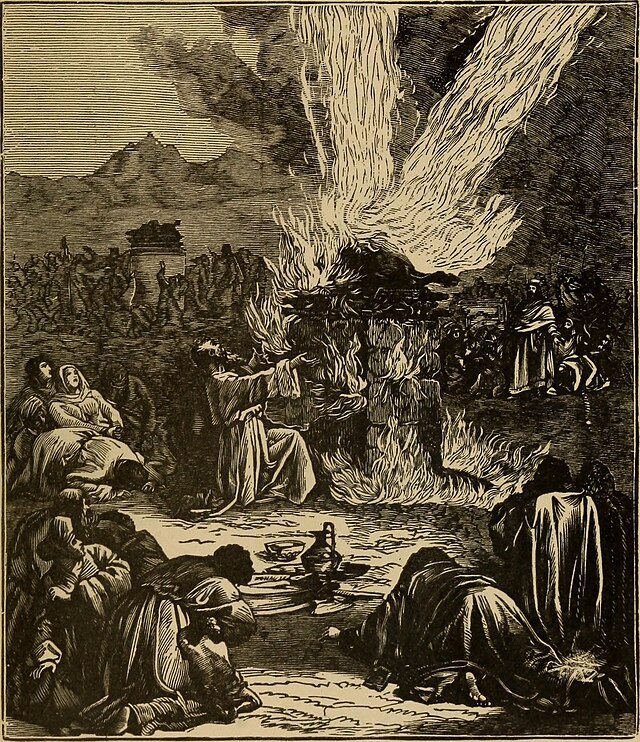
Ahab ran home with the story. Jezebel’s answer was a swift and animal death-threat: “I will make your life like one of them by this time tomorrow” (19:2). Jezebel didn’t wrestle with the implications, offer a public rejoinder, or confess like everyone else. The real person in charge breaks her silence, and Ahab’s voice becomes secondary.
Just like with Troy’s legacy, much of human history can be boiled down to men and women being unable to get along, and what God warned us about in Genesis 3:16, specifically, “Your desire shall be for [*or against] your husband, and he shall rule over you.“3 Often, behind one voice are the echoes of others.

In response, the once fiery prophet who both called down drought and fire without thought does the only thing left: he runs. Maybe this was the end of Elijah’s plan. Maybe, he imagined the entire nation would suddenly repent, and the rest of his life would go smoothly.
It did not, and the first person who wasn’t impressed with his theatrics sent him spiraling into a pity party. Elijah, the man who just took on and executed over 400 prophets, “was afraid, and he arose and ran for his life” because of the wife of the king he just embarrassed (v. 3). He seeks safety from Jezebel’s reach south of Beersheba in Judah, leaving his attendant, and walking alone into the desert until he collapsed under a rotem (broom) shrub. Scripture chose this shrub on purpose: not Sinai, not a holy tree, but an arid plant thriving in exhaustion and the margin. Ironically, it also called readers back to Hagar.
“In the wilderness, the broom tree offers a ‘miserable shade.’ It is the tree of the exhausted. Elijah’s wish for death under its branches is the honest cry of a man whose biological limits have finally vetoed his spiritual ambitions.”
— Abraham Joshua Heschel
Hagar & Exodus (1 Kings 19:1-8)
Two Scriptural cross-currents are hovering beneath the surface here:
The first is the Hagar echo. The near-identical biblical details, flight into the desert, collapse beneath a shrub, the simple divine response of water and bread, are not accidental. Specifically, Elijah is in the same setting (Beersheba, under a bush, waiting to die). Like Hagar (Genesis 21:15-21), Elijah is fleeing oppression by another woman and is treated as a vulnerable human first before being redirected. Scripture’s moral compass points to honest care over accusation. In both scenes, God’s first move was presence and provision, not pedantics. The God who vindicates in public always first tends to the person in private. Public without private is propaganda.
Worth noting is that Elijah is not looking like his former macho self here4.
The prophet who sought to command the weather now petitions death: “It is enough; now, O Lord, take away my life” (19:4). Carmel to a death wish in one narrative beat. The rhetorical slope is dramatic, but the narration is intentional: Elijah’s collapse was not a plot device for punishment; it’s the physiological tipping point of a person worn down by constant maximal performance. The plot reads like a clinical case history as much as sacred biography: hyper-activation, burnout, and collapse. Elijah stands as a warning to anyone in leadership with ambition and a vision, not just Ahab and Jezebel.
God’s response was domestic and bodily before it was theological. An angel touches him: “Arise and eat.” Bread baked on hot stones, a jar of water. So, Elijah eats, sleeps, and repeats. The angel’s second visit repeats the same imperative: eat for the road; the journey is too great for you (19:5–7). No scolding or cognitive reframing offered first. The Text insists: prepare the body to address the soul. That is the pedagogy, and kind of Jesus-ish.

Then, the second current is that Elijah was going on an Israelite-desert field trip for a change of perspective: “He went in the strength of that food forty days and forty nights to Horeb, the mount of God” (19:8). Forty days was deliberate. That number strings Elijah to the canonical movement of Israel: 40 years of wilderness testing, Sinai/Mosaic encounter, long-haul formation. This was something Elijah skipped while expecting apathetic and enslaved people to simply get it, and it showed. Elijah had been doing things backwards, starting where Moses ended, so God had to take him through the steps he skipped.
Elijah’s itinerary was not an escape; it was a retracing and re-initiation into what he assumed for himself. Like the 40 years for the Israelites or Jesus’ 40 days, the time wandering in deserts is where we are tested, ego falls away, and we learn to listen and trust. By no means is it a linear process, but it is a process. The wilderness is often where God takes people to get them away from the noise of others.
A simple lesson from 19:1–8 is that God will not re-authorize a mediator who is biologically depleted and psychologically calcified. The Text insists that somatic restoration (bread, water, sleep) and psychological clarity are a prerequisite to theological recalibration. The man who outran kings must first be taught to accept help. God’s answer is not condemnation but presence, care, and honesty as preparatory pedagogy.
This is not punishment. It is reset.
Horeb: Wind, Quake, Fire, Silence, & the Double Question (1 Kings 19:9-18)
“There he came to a cave and lodged in it. And behold, the word of the Lord came to him, and he said to him, ‘What are you doing here, Elijah?‘”
— 1 Kings 19:9
Elijah’s first response is, “I have been very jealous for the Lord, the God of hosts. For the people of Israel have forsaken your covenant, thrown down your altars, and killed your prophets with the sword, and I, even I only, am left, and they seek my life, to take it away” (19:10).
God responds, “Go out and stand on the mount before the Lord” (v. 11). Like Job, after sitting in the mess and searching for answers, Elijah is basically told, “Dress for action like a man; I will question you, and you make it known to me” (Job 38:3). No more hiding in a hole, wallowing.
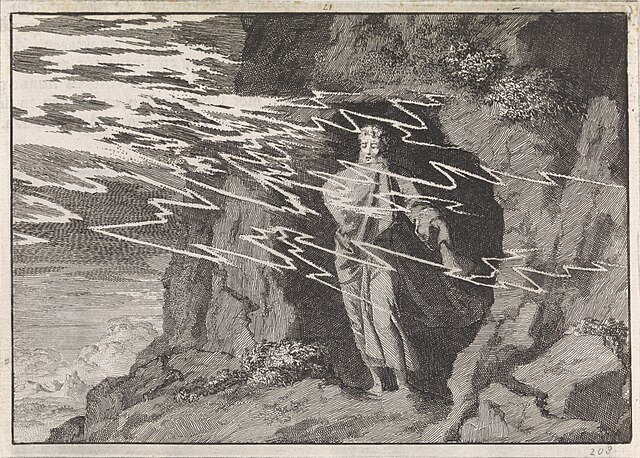
“And behold, the Lord passed by, and a great and strong wind tore the mountains and broke in pieces the rocks before the Lord, but the Lord was not in the wind. And after the wind an earthquake, but the Lord was not in the earthquake. And after the earthquake a fire, but the Lord was not in the fire. And after the fire the sound of a low whisper.”
— 1 King 19:11-12
The sequence deliberately echoes Sinai theophanies: wind, earthquake, and fire (Exodus 19:16-19). The formula “the Lord passed by” also appears in Exodus 33:19-23, Moses’ Sinai encounter. And yet, the Lord is not in those. The emphasis is on silence. Scripture frames Elijah as a new Moses-type mediator, while also having missed what Moses had.
The phrase “sound of a low whisper” (Qol demamah dakkah) is semantically ambiguous in Hebrew:
- Qol = voice/sound.
- Demamah = silence/stillness.
- Dakkah = thin/fine.
Scholars have noted that the theophanic mode is attenuation, not spectacle. Wind/quake/fire represent the non-identification of God’s presence5. When man-made assumptions about the created order are wiped away, the thin silence of God breaks through our clouded vision. It’s this Silence that often haunts and chases us behind our noise and hustle. And it’s a corrective to Elijah’s fire-from-heaven operational mode.6
“The ‘still small voice’ is not merely a psychological comfort; it is a polemic against the spectacular. It suggests that the fire on Carmel, while necessary, was not the final word. God is correcting Elijah’s theology of power, moving him from the ‘storm-god’ motifs of Baal toward the quiet, persistent sovereignty of Yahweh.”
— Dr. Ellen F. Davis
Then, God asks a second time, “What are you doing here, Elijah?” (19:13).
Elijah repeats verbatim: “I have been very jealous for the Lord, the God of hosts. For the people of Israel have forsaken your covenant, thrown down your altars, and killed your prophets with the sword, and I, even I only, am left, and they seek my life, to take it away” (19:14).
The same question from God, and the same answer from Elijah. Ask yourself, if the Divine has just done to you what He did to Elijah, after your first response, would you answer God’s question exactly the same? When our spouses or parents ask us the same question twice, do we not understand that our former answer was insufficient? It seems like Elijah had grown rather comfortable with his relationship with the Divine and couldn’t pick up the lessons He was dropping all along the way.
Scripture’s devices expose Elijah’s inability to revise his self-story. Wind, earthquake, fire, silence: none of it broke through. He can’t move past “I alone am left” to say “Here I am.”
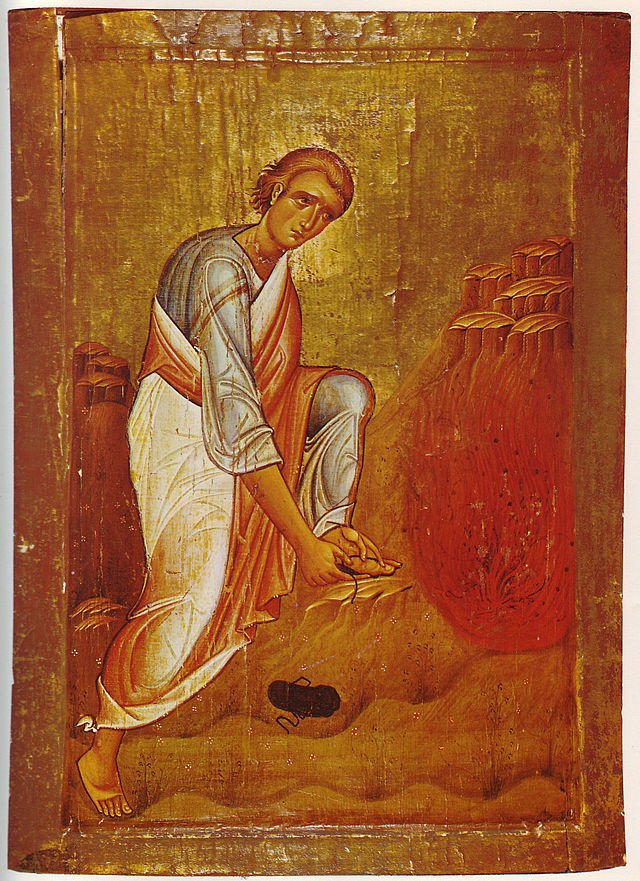
Elijah’s “Ox Crap” (1 Kings 19:14-18)
Elijah was not the only person left. That was in his head, and his head was full of himself. AA has a term for this: “toxic uniqueness.“7 The Bible already showed us Obadiah’s hundred prophets (18:4). Elijah’s inner narrative was factually wrong. And the Divine wasn’t impressed by his theatrics.
So, God redirects His prophet: “Go, return on your way to the wilderness of Damascus. And when you arrive, you shall anoint Hazael to be king over Syria. And Jehu the son of Nimshi you shall anoint to be king over Israel, and Elisha the son of Shaphat of Abel-meholah you shall anoint to be prophet in your place” (19:15-16).
“In your place” means finding his replacement. Elijah is directed to set affairs in order and then to take a back seat and pass off the reins. As we’ve explored in Part I, Elijah didn’t have a heavenly commissioning as did Moses, Isaiah, and others. Even here, his commissioning is a humble one, not the fire and brimstone he had imagined. His request to have his life ended has been ignored, and he’s sent back into the mess he helped create.
Then, God’s factual basis and the prophet’s correction: “Yet, I will leave seven thousand in Israel, all the knees that have not bowed to Baal, and every mouth that has not kissed him” (19:18). This is almost stated as a mercy, as if God could allow them to also exodus and seek refuge from Jezebel. It’s also a soft backhand to a stubborn prophet.
Seven thousand had not bent their knee, while managing families, bills, and the political oppression of a tyrannical king and his foreign spoiled squeeze. Elijah’s self-engrandizement has set him up for such a dramatic isolation. His ignorance of others and God’s people was precisely what Moses was not known for. Elijah’s entire self-understanding is wrong. And because he can’t revise it even after theophany, God retires him by giving him a “Joshua” to disciple.
Moses at Meribah struck the rock instead of speaking to it, collapsing God’s initiative and intent into a personal vindication. Moses’ cost was, “You shall not bring this assembly into the land.” Elijah at Carmel and throughout declared “by my word,” and collapsed God’s action into his prophetic speech.
At Horeb, even after fire and correction, he missed the seven thousand and couldn’t move past solitary heroism. So, his cost: “anoint to be prophet Elisha in your place.” Both failures involve mediatorial speech/action done for self-vindication rather than for the community. Both show an ego getting too comfortable speaking on behalf of the Divine for others.
“Elijah’s complaint that he alone is left is not only a sign of his despair but a symptom of his isolation. He has become a prophet without a people, and a leader who can no longer see the 7,000 who remain. God’s response is not a hug, but a replacement; Elisha is the cure for Elijah’s terminal uniqueness.”
— Walter Brueggemann
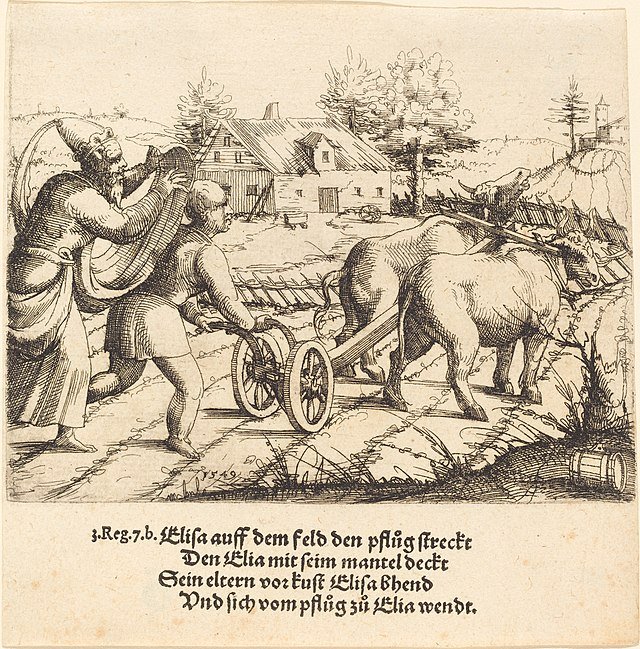
Elisha, Twelve Yokes, & Ritual Renunciation (1 Kings 19:19-21)
“So he departed from there and found Elisha the son of Shaphat, who was plowing with twelve yoke of oxen in front of him, and he was with the twelfth. Elijah passed by him and cast his cloak upon him” (19:19).
First, their names: Elijah & Elisha. Elijah means, “My God is Yahweh.” His name is a Declaration. It demands an answer to the question: Who is the true God? It’s more vertical in focus. Elisha’s name means, “My God is Salvation.” His name is about Trust and Transformation. It answers the question: How does God help His people? This is more horizontal in focus.
The contrasts continue: Elisha’s twelve yokes equals twenty-four oxen, both tribal numeric symbolism and economic indicators. This wasn’t subsistence farming. Elisha was rooted and established. He had family and obligations, as well as a promising future. And it was a lot more.
There are not just 12 yokes, but Elisha is also the 12th. He’s pulling oxen, unlike the donkey wrangler Saul was8. This is the Scripture hinting that Elisha was capable of unifying the 12 tribes of Israel, and I have to speculate that something is going on with the pairs of oxen. Scripture is forecasting the approach Elisha will take, one that involves all tribes.
“Elisha’s twelve yoke of oxen are not merely a sign of wealth; they represent the fullness of Israel. Where Elijah was a man of the desert and the fringe, Elisha is a man of the soil and the community. The transition of the mantle is a transition from the prophet as a lightning bolt to the prophet as a plowshare.”
— Marvin A. Sweeney
The old prophet finds Elisha and throws his cloak on him. It’s a visible symbol of a transfer position. It’s also awkward. The Text suggests Elisha was in the middle of working a field, and passes Elijah, when the old prophet just walks up behind him and throws the mantle on him. And apparently just walked away because in the next verse we read;
“And he left the oxen and ran after Elijah and said, ‘Let me kiss my father and my mother, and then I will follow you.’ And he said to him, ‘Go back again, for what have I done to you?’ And he returned from following him and took the yoke of oxen and sacrificed them and boiled their flesh with the yokes of the oxen and gave it to the people, and they ate. Then he arose and went after Elijah and assisted him” (19:20-21).
Elijah does not seem to be taking joy and delight in his assignment here, but Elisha’s response is also astounding: his only request was to kiss his father and mother goodbye. The fiery one gruffs back some sort of permissive statement.
So, instead of just kissing his parents goodbye, Elisha slaughters the oxen, burns the equipment, and throws a communal meal. While Elijah constructed 12 stones to offer one sacrifice, Elisha offered the 12 tribes and everything he had as an offering for the benefit of God’s people. Elijah’s first offering was a confrontation: Elisha’s is a reunion and departure. Total severance from previous life and family celebration are not mutually exclusive. This is ritual renunciation and complete vocational reorientation to take on the role of prophet.

Elijah was apparently not a part of the festivities since, afterwards, Elisha joined Elijah, leaving the old man with no excuse to ever say he’s the only one.
He’s embedded in the community from the start. Elisha’s feast was the funeral for his past and the inaugural ball for a new kind of ministry. Where Elijah was a storm-bringer who lived in the cracks of the desert, Elisha was a plowman who lived in the rhythm of the soil and the needs of his neighbors. Elisha won’t operate solo, but rather later with the “sons of the prophets” (2 Kings 2-6).
The mantle had been passed, but as we will see, a change in leadership will never be about a new name or a quick fix. It will be about a change of nature.
In Part IIIa, we explore the “Double Portion” and how Elisha tames the raw power of the fire-prophet into a ministry of healing and hospitality. Elijah’s arc continues to unfold until the chariots of fire finally arrive to take the lonely prophet home.
*Footnotes (& Leftovers):
- Sanctification is an embodied, grueling work of becoming whole, not a denominational exercise or doctrinal statement agreement. Modern political and consumer piety sells tidy solutions, but classic formation thinkers like Dallas Willard insist that discipleship is the slow, agonizing remaking of heart and habit. Holiness is a long, reorienting apprenticeship in undoing the human condition. Ironically, it’s the human condition that many churches want to remain in control of. ↩︎
- This principle, in part, is what I call the teleological attractor found throughout Scripture and fully embodied in New Testament anthropology, atonement, spiritual formation, christology, and eschatology. “A teleological attractor is a vision of the future that exerts a gravitational pull on the present, drawing individuals and communities toward a higher, more integrated state of being.” It’s the “coming of the son of man” as well as those moments the Holy Spirit smacks us to get us over our crap. For more info, check out The Son of Man & Its Mystical Awakening’s summary page. ↩︎
- Jezebel serves as more than a Phoenician queen; she is a theological cipher for the “femme-coded” shadow that corrupts some power and worship. While men have more than played their part in history, women are still the other half of it. This is not a male or female issue, but an ego and shadow one. Scripture hints at this with the whore riding the beast, as well as in Genesis 3:15. The author of Revelation explicitly uses her name as shorthand for false prophecy and ecclesial betrayal (Rev. 2:20). Jezebel is both historical and archetypal. ↩︎
- A recent article in the Journal of Religion and Health examined Elijah’s emotional and spiritual struggle from exegetical and psychological perspectives. It reads the phases in 1 Kings 18–19 not merely as dramatic episodes but as a coherent psychological trajectory: triumph is followed by despair, isolation, loss of confidence, and finally a reorientation in a quieter encounter with God. – ↩︎
- This “thinning” of the Divine presence at Horeb directly mirrors the deconstruction of God’s identity in Exodus 3:13-14. When Moses asks for a name, as all the gods Moses was aware of had, he’s met with “I AM WHO I AM,” a verbal refusal to be named. Rabbis and scholars (like Lawrence Kushner, Martin Buber, and Arthur Waskow) point out that the letters YHWH (the Tetragrammaton) are all aspirated: they’re essentially pure breath. In other words, you can’t pronounce them with a closed mouth. Just as the Name is an unpronounceable respiration, the “sound of a low whisper” (1 Kings 19:12 ESV) is a subversion of the spectacular. God refuses to be a “thing” Elijah can wield like fire, retreating instead into the haunting reality of mere being. ↩︎
- This “thin silence” serves as the sharp corrective for James and John, the “Sons of Thunder” (Mark 3:17), who famously asked Jesus if they should “tell fire to come down from heaven and consume” a Samaritan village (Luke 9:54). They were stuck in the Elijah-mode—assuming the fire of God was a weapon for their personal vindication against the “other.” The irony is that Jesus, the one who truly “will baptize you with the Holy Spirit and fire” (Matthew 3:11), rebukes the request. Jesus operates as the “Greater Elisha,” not the desert-dwelling lightning bolt, but the one who multiplies bread, heals the leper, and dwells in the messy rhythm of the community. He has the fire, but he chooses the table. The “Sons of Thunder” had to learn that the fire of God is for the refinement of the heart, not the incineration of the neighbor. ↩︎
- The concept closely resembling today’s “toxic individuality” is called “terminal uniqueness” in many AA rooms. This mindset, which fosters isolation and resisting help, is often linked to the addiction-driven “self-centeredness” that AA aims to overcome through shared experience and community. Here’s an interesting read from 2020 on how toxic “individuality” was becoming a problem then: https://www.psychologytoday.com/us/blog/culture-shrink/202005/how-america-fell-into-toxic-individualism. ↩︎
- Elijah’s trajectory sits within a larger biblical conversation about the failure of “chosen-one” leadership. Compare the arcs: Saul’s jealous collapse (1 Samuel 15), David’s messy, formative repentance (2 Samuel 12), and Elisha’s communal succession. Walter Brueggemann noted in his work on Samuel that biblical leadership is a constant negotiation between violence, vocation, and community. Elijah’s “failure” isn’t an anomaly; it’s a warning that solo heroics always end in the cave. For more, see this previous piece: Every Child of God: Debunking the “Chosen One” Myth ↩︎