Table of Contents Show
“Elisha is a second Joshua, but he is a Joshua who begins where the first Joshua ended. By retracing the conquest in reverse, the narrative suggests that the land has been ‘un-conquered’ by its own apostasy. The Jordan is no longer a door to a new world, but a boundary where the Spirit must retreat to find a clean vessel.”
— Peter Leithart
Author’s Note: This study got out of hand. What began as an exploration of Elijah morphed into something much larger and more necessary than anticipated. Part III was long enough to be broken in another two: IIIa and IIIb. After this series is done, it’ll be compiled into a single volume, revised, probably expanded, and made available as a free download.
If Elijah was the fiery prophet of the mountain, Elisha is the people’s prophet of the Earth. He makes his home not in distant lands, on mountain tops, or buried in caves, but with the people. His movements trace the prophet as he spreads his double portion of Spirit.
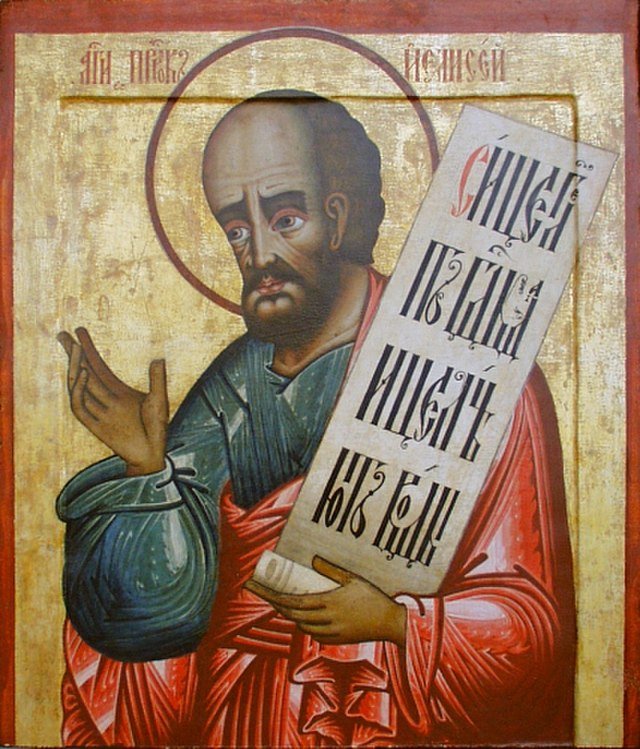
From picking up Elisha, Elijah starts to fade into the background. At the same time, other prophets step forward, including one who makes another man injure him as an object lesson to the king (1 Kings 20:35ff), and another named Micaiah.
In 1 Kings 22, when Micaiah comes up, it’s because of the two different kings of the divided kingdom, Ahab & Jehoshaphat, who are debating going into war. Jehoshaphat is trying to be a good king and follow the Lord, so he wants to inquire of the Lord. However, Ahab isn’t happy about Jehoshaphat’s request because Micaiah already had a reputation, and Ahab already had 400 prophets: almost the same number that Elijah had killed had already been replaced. False prophecy thrives where power desires affirmation more than truth. (c.f. 1 Samuel 8:7). They’re usually extensions of the thrones they serve.
So, when Jehoshaphat said, “Is there not here another prophet of the Lord of whom we may inquire?” Ahab responded that there was “one yet” (1 Kings 22:7-8). Elijah and Elisha are no longer available in the narrative, and there was one other who had “the word of the Lord” (v.5). When Micaiah arrives, it’s a scene: Two kings with a ramble of prophets. He doesn’t disappoint as a character, sarcastically taunting Ahab before speaking the truth of his destructive ends coming, for which he’s imprisoned for an unspecified amount of time, and fades into the background.
1 Kings ends with Jehoshaphat dying as one of Judah’s most awkward kings, trying to follow the Lord but yanked around by Ahab, while Ahab’s son can only rule for two years because he followed in his father’s and mother’s footsteps “in every way” (1 Kings 22:52-53).
This unresolved tension sets the scene for 2 Kings.
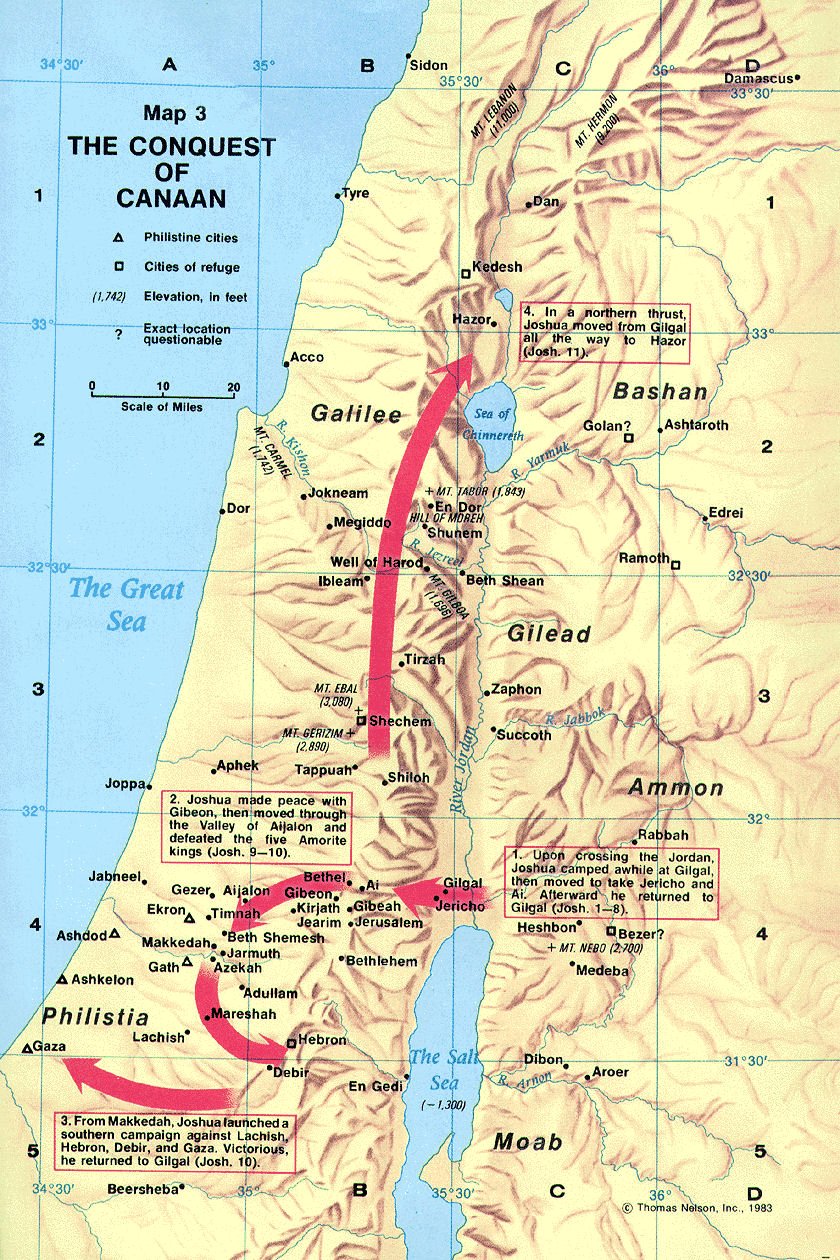
The Reverse Conquest (2 Kings 2:1–8)
Elijah’s final journey wasn’t random. He retraced Joshua’s path of conquest in reverse: from Gilgal to Bethel, and Jericho to Jordan. Elijah seems to be suggesting that Israel had been conquered without realizing it, as if they had forgotten everything in the wilderness. Elijah would, after all, not see the fruits of what he started.
2:1 tells us that Elijah was about to be taken up in a whirlwind. But first, and apparently, “the sons of prophets“1 knew about it and so sought to comfort Elisha:
Elijah said to Elisha, “Please stay here, for the Lord has sent me as far as Bethel.” But Elisha said, “As the Lord lives, and as you yourself live, I will not leave you.” So they went down to Bethel. And the sons of the prophets who were in Bethel came out to Elisha and said to him, “Do you know that today the Lord will take away your master from over you?” And he said, “Yes, I know it; keep quiet.”
— 2 Kings 2:2-3
Three times, the sons of the prophets come out at each of his spots, and twice they tell Elisha the obvious: “Do you know that today the LORD will take your master from over you?” (2:3, 5). Two times, Elisha said he already knew. Three times, Elijah told Elisha, “Please stay here, for the Lord has sent me…” and Elisha refused. There’s a tenderness here, and also a kind of prophetic stubbornness that Elisha will carry for the rest of his ministry. He knows and will not leave the old man. Grace and tenacity coexist without one canceling the other out: not far from a functional definition of love.
50 of the prophets join the two up to the river. When they come to the Jordan, and Elijah replicates Israel’s first Jordan crossing, and the pair cross. It was the physical symbol of the prophetic office, the same material the text uses to mark Elijah from his very first appearance.
“And Elijah took his cloak and rolled it up and struck the water, and the water was parted to the one side and to the other, till the two of them could go over on dry ground.”
— 2 Kings 2:8
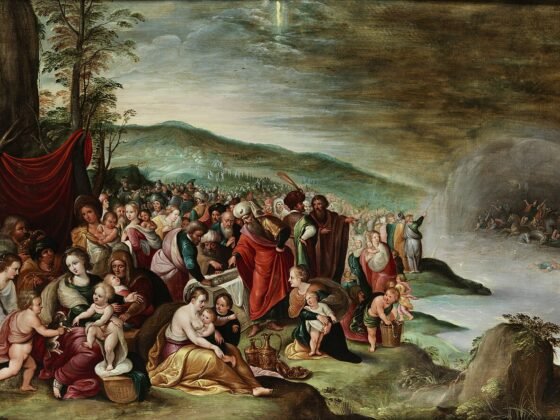
The language of Elijah striking the water and crossing “on dry ground” deliberately echoes Joshua 3. The sons of the prophets watching from the other bank would have caught it instantly. The Jordan crossing functions in Deuteronomistic theology as a boundary marker of covenant history. By doing so, Elijah symbolically crosses the covenant boundary, outside of the Promised Land, to finish his journey, just as Moses did. Instead of initiating conquest, he concludes a prophetic cycle. Instead of establishing covenant loyalty, he departs during national apostasy.
Succession: The “Double Portion” (2 Kings 2:9–14)
When they had crossed, Elijah said to Elisha, “Ask what I shall do for you, before I am taken from you.” And Elisha said, “Please let there be a double portion of your spirit on me.” And he said, “You have asked a hard thing; yet, if you see me as I am being taken from you, it shall be so for you, but if you do not see me, it shall not be so.”
— 2 Kings 2:9-10
This isn’t about Elisha having twice the power of capabilities, like some MCU character. “Double portion” (pi shenayim) is a Hebrew legal term, calling back to the Law of the Firstborn in Deuteronomy 21:15-18, protecting the son of an unloved woman. The eldest son, regardless of parental preference, in ancient Israelite law received a double portion of the inheritance because he bore the primary financial responsibility for the family’s continuity and care.
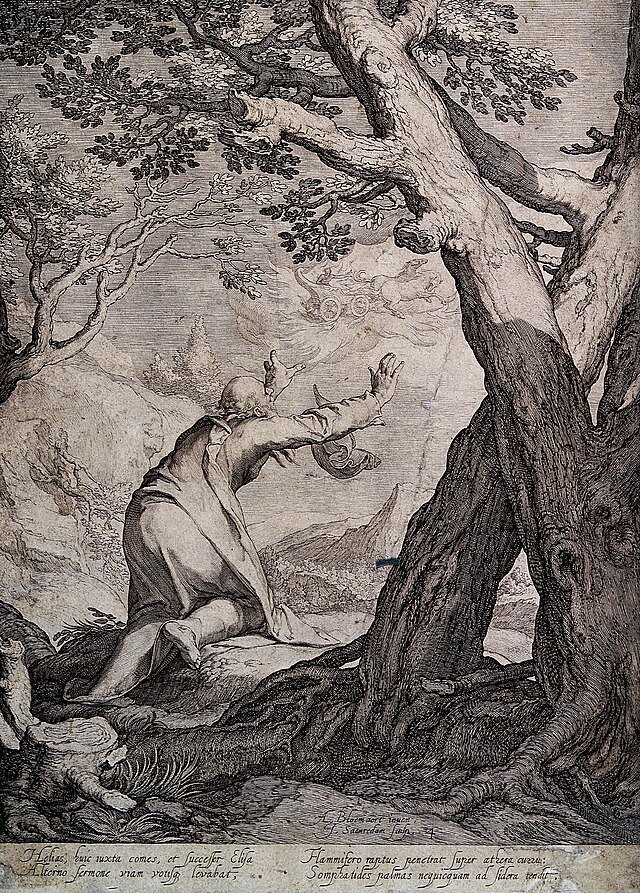
So, Elisha is not asking Elijah for more mojo. He is asking to be recognized as Elijah’s legal successor and to have his full blessing. Up to this point, ever since leaving his family, Elisha has been under Elijah’s tutelage, or pedagogy. Upon Elijah’s departure, Elisha would be the heir to Elijah’s prophetic role, the one responsible for the sons of the prophets. Elisha is asking for the right and the responsibility of succession.
Elijah’s answer is curious: “You have asked a hard thing” (2:10). Elijah conditions its fulfillment on whether Elisha actually sees him taken. Of course, Elisha does.
“And as they still went on and talked, behold, chariots of fire and horses of fire separated the two of them. And Elijah went up by a whirlwind into heaven.” And Elisha saw it and he cried, “My father, my father! The chariots of Israel and its horsemen!” And he saw him no more.
— 2 Kings 2:11-12
The vocabulary of rekev (chariots) and parashim (horsemen) belongs to Israel’s military lexicon. In the broader canonical tradition, from Exodus 15 to Psalm 68, chariot imagery signals YHWH as the divine warrior. The repetition of “chariots and horsemen” in 2 Kings 6 confirms that what Elisha saw was not a metaphor but mobilized heavenly defense.
“My father, my father! The chariots of Israel and its horsemen!” (2:12) is not merely expressing grief. Elisha was making a theological statement: this man, now his adopted father, was Israel’s true defense. Not Ahab’s cavalry or the palace’s political machinery. The prophet who stood in covenant fidelity before God was worth more to Israel’s security than all of Ahab’s imperial spending put together.
And now Elijah was gone. The whirlwind was over. Elisha stands at the far side of the Jordan, with a dirty camel-skin cloak and one question:
“Where is the LORD, the God of Elijah?”
— 2 Kings 2:14
There is no answer, at least not verbally. His answer will come in a moment.
That question was a nakedly honest moment, without a doubt: Elisha’s mentor exited, leaving him alone (something Elijah repeatedly asked Elisha to do), and all that remained was dirt, water, sweat, camel hair, and Elisha. Elisha was on his own journey now, and his own pedagogue with the Divine. It was his turn to step up.
So, he strikes the river, and, also, and it parts. The prophet has his answer. God is with him.
Bethel: The Bear Situation (2 Kings 2:23–25)
Before Elisha leaves the prophets, they insist on sending a search party for Elijah. After they don’t find him, Elisha basically says, “I told you so” (v. 18). Then Elisha performs his first public miracle, turning their local spring, which had gone bad, into fresh water to make it pure. The symbolism is rich2, while Elisha’s candor is mellow.
Immediately after leaving the prophets, Elisha encounters a different group. Not 50 prophets, but 42 or more youth. Earlier still, there were also three sets of 50 royal soldiers with Elijah (2 Kings 1)3.
Before Elijah’s ascension in a chariot, in 2 Kings 1, two separate companies of fifty soldiers, plus their captains, are consumed by fire when they confront Elijah. A third company of fifty approaches differently and is permitted to live. The threefold royal approach to Elijah was also echoed by three prophetic-community encounters with Elisha before the Bethel episode (2:3, 5, 7), reinforcing the theme of authority being tested and recognized.
Some scholars connect 42 to judgment symbolism elsewhere:
- In 2 Kings 10:14, Jehu slaughters 42 relatives of Ahaziah.
- In 2 Chronicles 22:2, 42 appears again in a dynastic context.
Not contextual here, but in Revelation 11–13, 42 months is a time of oppression and judgment. The recurrence of forty-two in royal judgment contexts suggests Scripture is not careless with its numbers.
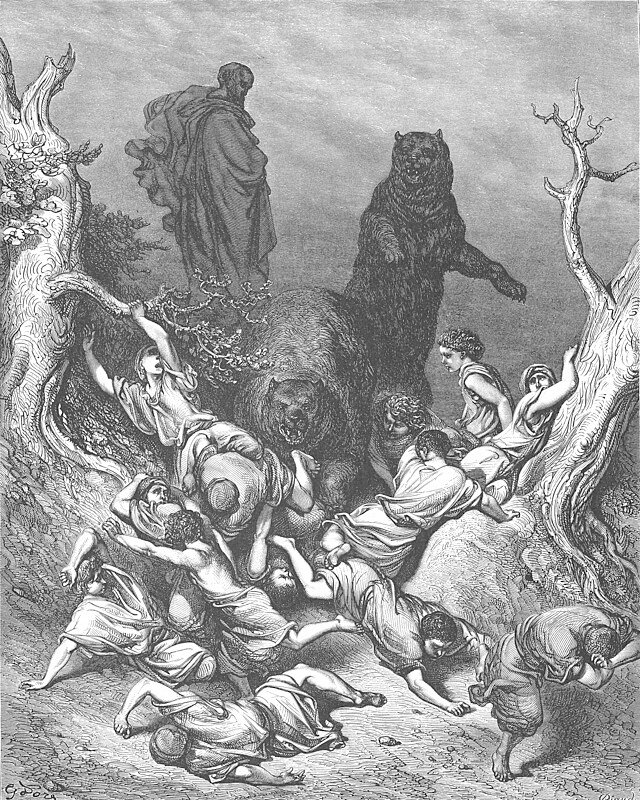
“He went up from there to Bethel, and while he was going up on the way, some small boys came out of the city and jeered at him, saying, ‘Go up, you baldhead! Go up, you baldhead!’ And he turned around, and when he saw them, he cursed them in the name of the LORD. And two she-bears came out of the woods and tore forty-two of the boys.”
— 2 Kings 2:23–25
As Elisha leaves, freshly bereaved, a gaggle of youth mocks him, and so he “curses” them. Then two female bears “tore forty-two” of them, implying there was more. Just so we don’t think Elisha had over-reacted and just slaughtered a bunch of children, here’s the Hebrew and historical context:
- “Tore” (baqa): It means “to split” or “to breach,” but does not necessarily mean “killed,” though the force of the word leans obviously toward bodily injury and possible fatalities.
- “Small boys” (ne’arim qetannim): The noun na’ar does not uniformly mean “young child.” The word is used in the Hebrew Bible to describe Joseph at seventeen (Genesis 37:2), Absalom as a military-age man (2 Samuel 18:5), and Solomon at the beginning of his reign, asking God for wisdom because he is “but a na’ar” (1 Kings 3:7) — and not a child when he said that. Ne’arim qetannim designates young men, adolescents at the very youngest. There are forty-two of them, minimum, which suggests this was not a spontaneous encounter with some neighborhood kids.
- “Baldhead” (qereach): In the cultural context of Iron Age Israel, a shaved or bare head was associated with various aspects, including mourning, old age, leprosy, and ritual uncleanness. Mocking the new prophet of Yahweh also meant they were exposed. It’s the equivalent of protesting a funeral procession, and being surprised when the parents beat you up for it.
- Bethel was the institutional headquarters of the state-sponsored idolatry established by the Omride dynasty: one of the two sites where Jeroboam set up the golden calves (1 Kings 12:29). It was, in the political geography of the divided kingdom, an openly hostile religious and ideological center. Elisha walking into Bethel alone, as the newly confirmed successor of the prophet who had killed 450 of the regime’s prophets, was not a neutral act. He was walking into enemy territory on the first day of his independent ministry.
- “Go up” (aleh): the taunt is not a generic mockery of a bald man, but likely a reference to Elijah’s alah, his ascension in the whirlwind. The crowd was saying, “Go up like your master did. Get out of here.” Elisha’s presence wasn’t wanted there. The subtext is not just childish, but organized intimidation directed at the prophet’s legitimacy.
Rather than cursing or calling down fire, Elisha invokes the covenantal logic of Leviticus 26:21–22, in which God warns Israel that persistent covenantal opposition may invite wild animals into the land. The imagery of she-bears, especially with cubs, reflects the biblical pattern of dangerous maternal wildlife (cf. Hosea 13:8), reinforcing the severity of covenant boundary enforcement rather than suggesting arbitrary rage.
“The Bethel incident is the first judicial act of the new heir. Bethel was the nerve center of the state cult; the ‘youths’ were its acolytes. By invoking the Levitical curses of the wild beasts, Elisha demonstrates that the ‘Double Portion’ includes the authority to enforce the sanctions of the broken contract. It is a terrifying return to the Law.”
— Thomas Brodie
The narrative tension also sits within the broader pattern of women and children at the margins of the story. Between the two prophetic cycles are two widows and two dead sons, and the shadow of Jezebel’s death hangs over the closing of Ahab’s house. Against this background, the episode at Bethel can be read as part of the text’s larger theological concern with covenant fidelity across social vulnerability rather than as an isolated act of hostility.
And, after all, if “hell hath no fury like a woman scorned,” then the wrath of God may be terrifying, but His love more so, since that is all He is (1 John 4:8).
Elisha acted as a prophetic covenant-enforcer, not a man in a rage. The prophet still had bite, and the Created Order was on God’s side, not empires’.
“The prophet is not a man who operates from a pinnacle of power, but one who mediates between God and the human being sunk in the depths.”
— Abraham Joshua Heschel
Jehoshaphat’s Moabite Problem (2 Kings 3)
With the mantle passed and prophetic succession ratified at the parting Jordan, Elisha’s ministry turns away from Ahab’s court. He is not done dealing with kings, but his center of gravity was decisively different from Elijah’s.

In 2 Kings 3, Jehoshaphat of Judah again finds himself entangled with a northern monarch, now Joram, son of Ahab. Facing a military crisis, he repeats the question he once asked in Ahab’s court: “Is there no prophet of the LORD here, that we may inquire of the LORD by him?” (3:11, c.f. 1 Kings 22:7).4 Previously, the answer was Micaiah. Now, it is Elisha.
Elisha’s posture is corrective but measured (2 Kings 3:14) . Instead of calling down fire or speaking a prophecy, he calls for a musician. Instead of announcing only drought, he promises water. His mode of revelation shifts from confrontational spectacle to participatory and mediated restoration.
Elisha’s ministry increasingly shifts toward private spaces, focusing on widows, barren women, indebted families, and prophetic households. The prophet who inherited the mantle does not retreat from political reality, but he relocates the center of prophetic action. He enters kitchens and bedrooms.
The Widow’s Oil and Shunammite Woman (2 Kings 4)
The next narrative we get is of a widow in debt (2 Kings 4:1–7). Her husband was one of Elisha’s servants and “feared the Lord.” Now, the widow’s creditor is coming to take her two sons as debt-slaves; a legal reality in ancient times. She shares with Elisha, without request. His response is, “What do you have in the house? And she said, “Your servant has nothing in the house except a jar of oil” (4:2).
Here, Elisha tells this widow to borrow every empty vessel she can find from all her neighbors. In 1 Kings 17, Elijah went to a widow in Zarephath, and God miraculously provided flour that never ran out. Elijah was the vessel and God the sole actor, while the widow watched.
Elisha makes her recruit the neighborhood. The miracle, when it comes, flows through a community-generated infrastructure of borrowed vessels. Only when the last jar is full does the oil stop. The amount of oil produced was exactly proportional to the communal risk taken. Before Jesus fed 5000 with a boy’s generosity, Elisha sustained a community through itself.
“Elisha acts not as a solitary wonder-worker but as a facilitator of distributed grace. The miracle restores her economic viability so she can pay the debt and live — but it required her neighbors, and Elisha refuses to be the solitary thaumaturge Elijah was.”
— Walter Brueggemann
The pattern holds in the Shunammite woman’s story immediately following (4:8–37). A wealthy woman in Shunem noticed Elisha passed through her town regularly. This region was firmly under the rule of the northern kingdom of Israel. She, and her husband, built him an upper room, a space for hospitality. The Text records her reasoning as, “I know that this is a holy man of God who is continually passing our way” (4:9). This woman doesn’t need to be convinced. She was paying attention to an approachable man.
Elisha asks what she would ask in return, perhaps a favorable word to the ear of the king or a commander of an army. All she said was, “I dwell with my own people” (v. 13). Refusing to take “no” for an answer, Elisha asks his servant, Gehazi, what she needs. Elisha learns she “has no son, and her husband is old” (v. 14).
So, Elisha promised her that in a year, she’d be holding a son. Despite her disbelief, it was so. For a year, Elisha lived here and witnessed the birth of her child. The next story begins with “when the child had grown…” meaning Elisha spent years in Shunem.
While Elijah hid at the Cherith brook, alone, fed by ravens, cut off from human contact, Elisha walked the streets and had a room built for him by people who loved him. The prophet had a place to lay his head, and a home that. Elisha chose to invest in his presence while Elijah’s ministry was set on spectacular intervention. Elisha’s was sustained through relational embeddedness: that’s his bread and oil.
So, when the Shunammite’s son collapses and dies, the woman knows who to seek. Ignore her husband’s contestation, she says, “All is well‘ and goes to “the man of God,” Elisha, who was not insignificantly at Mount Carmel (v. 23, 25).
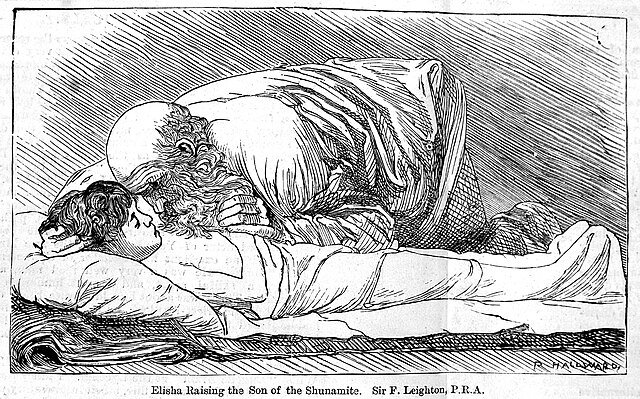
Elisha’s response is intimate. He sends Gehazi ahead with his staff, a seemingly efficient prophylactic measure that does nothing (v. 31). When Elisha himself arrives, he doesn’t pray loudly over the body, perform a public ritual, or call down fire. He goes into the room alone and closes the door.
“He went up and lay on the child, putting his mouth on his mouth, his eyes on his eyes, and his hands on his hands. And as he stretched himself upon him, the flesh of the child became warm… and the child sneezed seven times, and the child opened his eyes.”
— 2 Kings 4:34–35
More than Elijah’s throwing himself on the boy three times, Elisha wraps his own body around the boy’s. Elisha goes eye-to-eye with death. The seven sneezes are an odd detail that Scripture preserves, hinting at Creation. The prophet’s body becomes the method, and the body of the child a faithful witness. Elisha’s miracle wasn’t “super” natural: It was natural, embodied, localized, and pastoral. The scene insists that prophets work like midwives, not just megaphones. These occurrences were his chance to teach Israel how to be what he was, his pedagogy of the people.
There is also a quiet lesson here. Shunem sits in contested plain-country; the same geography hosts Naboth’s vineyard and Jezebel’s poison. Renewal taking root in a woman’s upper room is not an accident. The author stages a restoration where courtly power had tried to monopolize life and death. The miracle’s domestic locus is a political counter-claim: covenant life will be rebuilt at ground level, not behind palace gates.
Anti-Spectacle & God’s Range of Modes (2 Kings 5:1–14; 6:1–23)
As Elisha’s fame spread, empires eventually came knocking. Naaman, commander of the Syrian army, a leper, arrives at Elisha’s door with an entourage and a payment amounting to several hundred pounds of silver, sixty pieces of gold, and ten sets of clothing (5:5). He is expecting a performance.
Elisha does not come to the door and rejects the payment. He sends a messenger with a prescription: go wash in the Jordan seven times. That’s it.
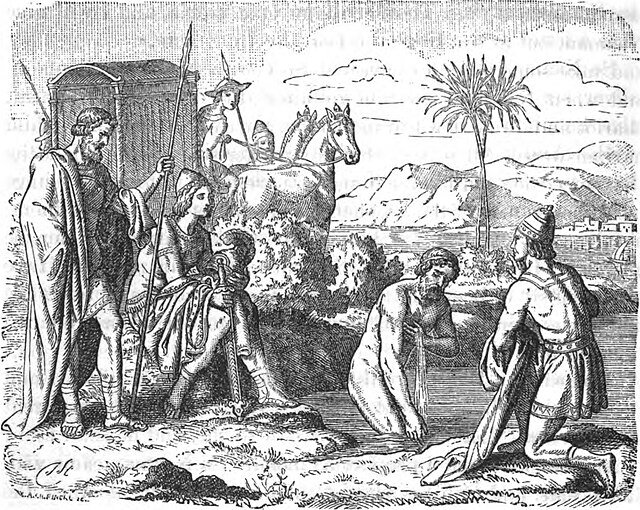
Naaman’s response was, “Behold, I thought that he would surely come out to me and stand and call upon the name of the LORD his God, and wave his hand over the place and cure the leper” (5:11). Such a recognizable human reaction inside Scripture. He had a plan for how a miracle was supposed to look. Elisha declined to audition for it. The Israelite servant girl who first told Naaman about Elisha (5:3) is the real hero of this story and a quietly devastating refutation of faux-theology that reserves God’s communication for the powerful: a captive child, a Gentile general, and a prophet who wouldn’t even come to the door together accomplish what the Syrian medical establishment could not.
Naaman washes and is healed. While he wants to pay, Elisha refused emphatically as aggressive theological boundary-keeping: the grace of God is not a commodity, no market price, and Elisha will not be a tool by which the Divine becomes transactional.
Gehazi, Elisha’s servant, watches and immediately runs after Naaman to collect what his master refused (5:20–27). His subsequent punishment, leprosy, was not disproportionate cruelty but a painful object lesson. It was the covenant’s response to the commodification of grace, the same boundary Elisha drew, now enforced in Gehazi’s own body. The contrast between Elisha’s refusal and Gehazi’s greed is deliberate and carried forward. Spiritual authority corrupted by financial entitlement is an ugly pattern in human history, and Scripture does not forget it easily.
Almost immediately after Naaman, one of the sons of the prophets wants to build a place to dwell in, and wrangles with Elisha to make a trip to the Jordan to cut down some trees. While they were cutting, a tree was falling, and one of their axe heads fell into the Jordan. The problem was that the axe head was borrowed (6:1–7). Axe heads were a big deal for ancient humanity.
Elisha cut a stick and threw it in the water, making the iron float. A practical, domestic, economically significant problem for a person of no political consequence is met with the same prophetic attentiveness as a Gentile general’s leprosy.
Some time later, the Syrian army surrounds Dothan (6:8–23). The servant wakes up to horses and chariots encircling the city and is understandably terrified. Elisha’s response:
“Do not be afraid, for those who are with us are more than those who are with them. And Elisha prayed and said, ‘O LORD, please open his eyes that he may see.’ So the LORD opened the eyes of the young man, and he saw, and behold, the mountain was full of horses and chariots of fire all around Elisha.”
— 2 Kings 6:16–17
The chariots of fire here are not Elijah’s departure in reverse. They are the permanent reality Elisha’s servant simply could not see. The world is fuller than the visible. Elisha does not call the chariots down as weapons. He asks that his servant’s eyes be opened.
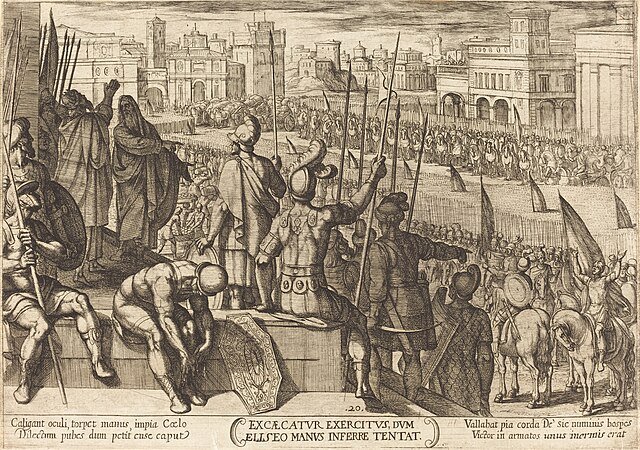
As the army is charging, Elisha prays that they be struck with blindness. Then, when they are blind, he goes out and meets them. The whole thing is worth reading as a whole. Elisha first says to them:
“This is not the way, and this is not the city. Follow me, and I will bring you to the man whom you seek.” And he led them to Samaria.
As soon as they entered Samaria, Elisha said, “O Lord, open the eyes of these men, that they may see.” So the Lord opened their eyes and they saw, and behold, they were in the midst of Samaria. As soon as the king of Israel saw them, he said to Elisha, “My father, shall I strike them down? Shall I strike them down?” He answered, “You shall not strike them down. Would you strike down those whom you have taken captive with your sword and with your bow? Set bread and water before them, that they may eat and drink and go to their master.” So he prepared for them a great feast, and when they had eaten and drunk, he sent them away, and they went to their master. And the Syrians did not come again on raids into the land of Israel.
— 2 Kings 6:19-23
The conflict was resolved not by the massacre of the Kishon but by bread and hospitality. Where Elijah ended a contest with a blood-soaked riverbed, Elisha ends an invasion with a dinner party. The defense he offers is revelation and reconciliation, not spectacle; sight, not slaughter. Community, not conquest.
The same God, working through two servants whose names are almost identical, has landed at entirely different methods, and both are in Scripture, which means both tell us something true about the range of the Divine. God is willing and able to use anyone, willing and unwilling.
“The ‘double portion’ given to Elisha is the grace of the two-fold love: the love of God and the love of neighbor. Elijah lived in the solitary love of the mountain, but Elisha was called to the dual life—the contemplation of the Divine and the active service of the widow. He is ‘double’ because he refuses to choose between the altar and the table.”
— Gregory the Great
In Part IIIb, we move to the final closure of Elisha’s era. We’ll explore the violent, inevitable end of Jezebel and a transition of power that shakes the foundations of the Northern Kingdom. Meanwhile, there’s a curious pattern that defines Elisha’s ministry that we have grazed over but have yet to unearth. This structural symmetry will show us a God who meets us in every category and corner until there are none left.
*Footnotes (& Extras)
- The prophetic guilds (bene hannevi’im, “sons of the prophets”) appear throughout 2 Kings 2–6 as Elisha’s primary community of practice. Archaeological and textual evidence suggests these were established residential communities, likely near population centers, with Elisha maintaining itinerant relationships with multiple guilds simultaneously. The fact that they appear at Gilgal, Bethel, Jericho, and the Jordan in 2 Kings 2 alone, all four sites on Elijah’s final itinerary, suggests that the geographic placement of these communities was intentional and theologically significant, mirroring the same sacred geography of Joshua’s conquest. ↩︎
- This is a call back to Moses healing the pool of Marah (Exodus 15:23-27), which was one of the three tests Israel had to go through in the desert. The pool of Marah is about our bitterness and discontentment, how quickly we’d go back to our old slave-masters for a little comfort. Egypt was a common oppressor of Israel and the ANE. Ancient Israelites were not just familiar with their neighbors’ theologies, but often married them while sleeping with the milkman. ↩︎
- This happens to equal 153: (50 + 1) x 3, which only appears in John 22. ↩︎
- Jehoshaphat remains one of the more paradoxical figures of the Davidic line; a genuine reformer whose spiritual instincts were frequently throttled by a recurring diplomatic gullibility. While his legacy is anchored by his radical faith, seen in 2 Chronicles 20, where he marches against a coalition of enemies with nothing but a choir and the plea, “We do not know what to do, but our eyes are on you,” his other-king-entanglements reveal a chronic inability to lead. This wilderness crisis in 2 Kings 3 is a structural echo of his near-death experience at Ramoth-Gilead (1 Kings 22). Despite his personal righteousness, he is “spanked” by Elisha’s biting remark in verse 14, that he would not even look at Joram if not for Jehoshaphat’s presence, serves as a sharp judicial reminder that the King of Judah is once again out of place, risking the Davidic seed for the sake of an unholy and unnecessary alliance. The Old Testament is the Hero’s Journey, fractured, interwoven by the Divine pulling it all back together. ↩︎