Table of Contents Show
There’s a pattern in Jacob’s story, the grandson of Abraham. It’s one that chased me until it brought me to an end.
“Grace is not opposed to effort, it is opposed to earning. Earning is an attitude. Effort is an action. Grace, you know, does not just have to do with forgiveness of sins alone.”
— Dallas Willard, The Great Omission
Jacob the Grasper
Jacob was the second-born twin; his brother was Esau. They did not resemble each other at all.
In a time when the firstborn held the family blessing and legacy, these twins would not be equals, at least initially.
So, the story goes, Jacob first takes advantage of Esau’s hunger to make him trade his birthright in exchange for a meal. Then, at his mother’s prompting, Jacob also stole Esau’s blessing by faking his identity to his older and blind father.
Jacob’s name meant heel-grabber, or deceiver. Either way, it was fitting, because Jacob was a trickster always grasping for more. It was a family trait: his mother Rebekah had taught him that if you want God’s promise to happen, you have to scheme and control the narrative.
After angering his brother, Jacob feared for his life, and his mother prompted him to flee.
While running, he had his first recorded encounter with God, the famous stairway reaching from earth to heaven, with God’s messengers ascending and descending on it at Bethel. He was surprised to find God even on the run, in that place.
Despite this, he kept running and set up a new life with distant relatives. Jacob met this match in his uncle, Laban. After having his bride-to-be switched on him without permission and being swindled for another seven years of work, he was upset.
Jacob’s Wages
An important Hebrew word keeps appearing: “wages” (śākār – “wages, payment, reward”). Part of Jacob’s deeper problem is that he wants what he’s owed. Jacob isn’t against blessing. He’s opposed to uncertainty.
The language of wages keeps following Jacob. He works for his wives. He works for his flocks. He negotiates his compensation. Laban changes the terms. Jacob changes his strategy. Everybody is keeping score. Relationships have become transactional.
He set up his escape and ran home. As he approached home for the first time in 20 years (Genesis 31:41), he stopped before the final approach. He first sent his family and belongings in waves ahead of him, with messages to his brother Esau of blessing and praise.
Jacob stayed behind overnight, clearly still afraid of his brother. It’s during that night that a strange figure appears to Jacob, and they wrestle with each other.
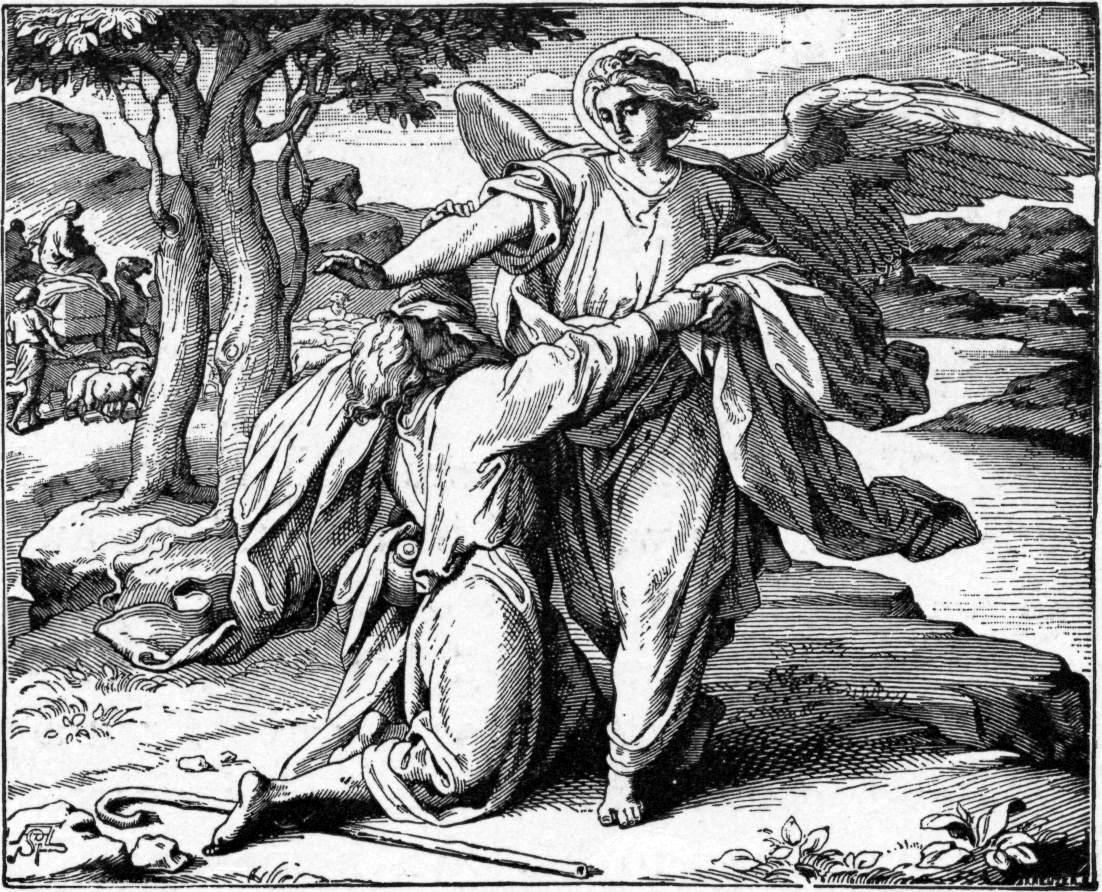
As dawn is about to break, Jacob refuses to let go without a blessing. The figure asks him what his name is. The last time he was asked that, he lied to his father to steal his brother’s blessing—the very thing that started this whole journey, which he must now face.
The mysterious figure dislocates Jacob’s hip and then blesses him. His identity remains strangely ambiguous. Jacob’s own conclusion is enough for the story: he encountered God face-to-face and survived.
Jacob names the place Penuel because he saw the face of God and lived.
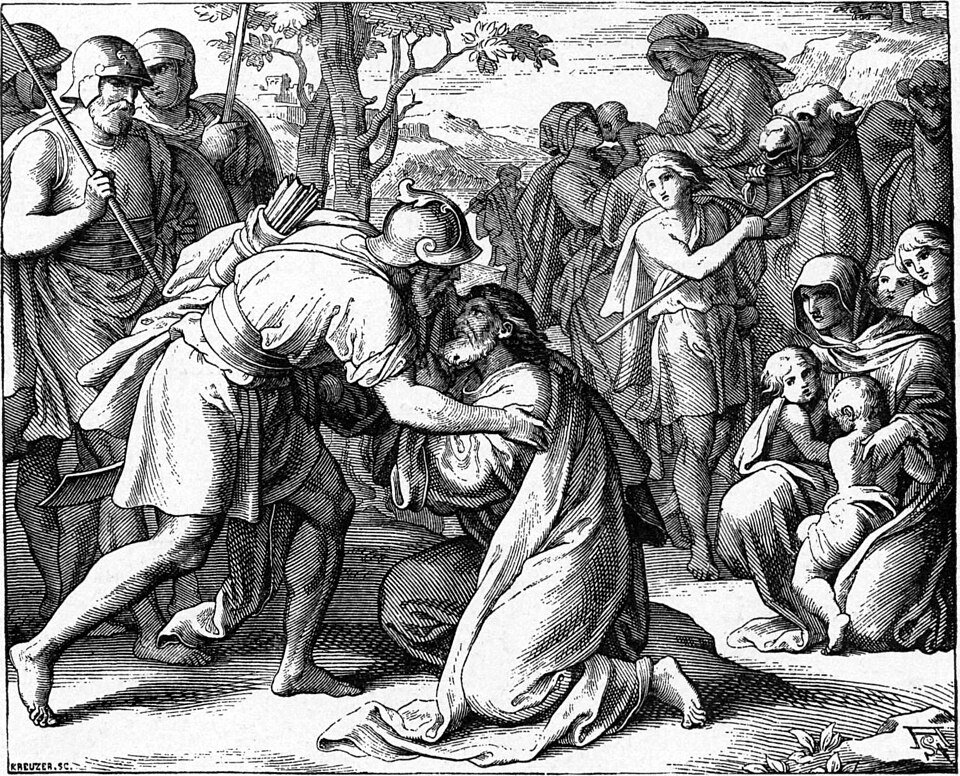
The next day, instead of a battle with Esau, Esau runs to, embraces, and kisses him—an encounter that echoes Jesus’ later story of the Prodigal Son. In response, Jacob says, “To see your face is like seeing the face of God” (Genesis 33:10). The brother Jacob expected to meet as an enemy becomes part of his encounter with God.
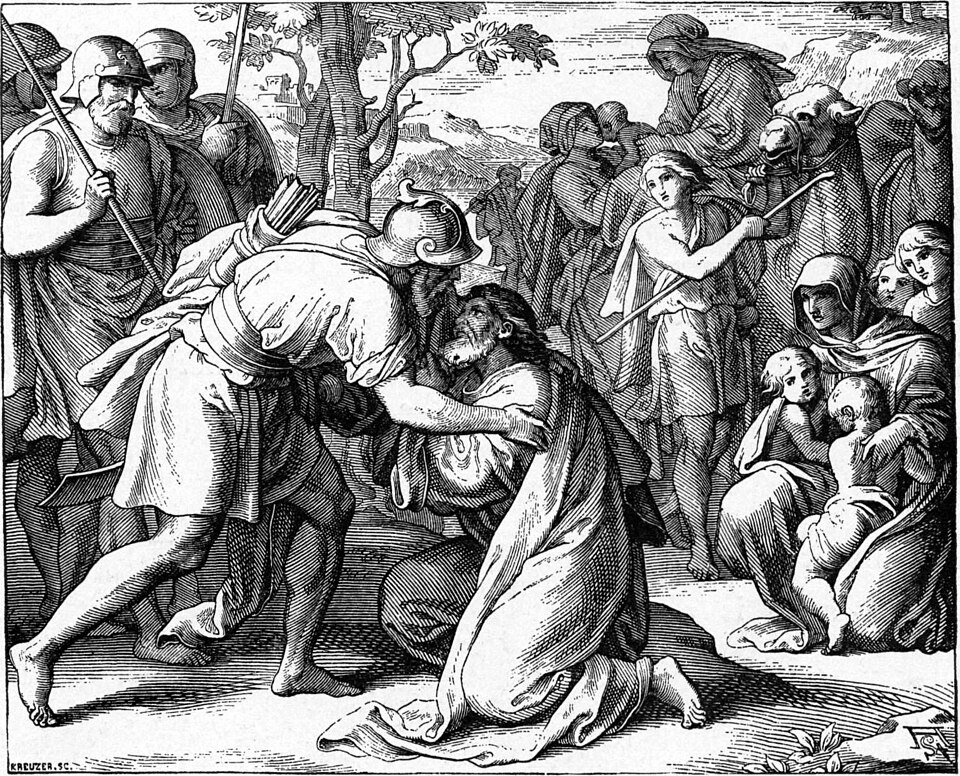
Jacob spends much of his life trying to secure by strategy what God had already promised to give by grace. His transformation begins when he can no longer manipulate the outcome.
While he made the journey home, his wages would follow him. The way he lived would influence the stories unfolding around him. Rachel would die while giving birth to his final son, Benjamin, the youngest after Joseph.
Commentators point out that Rachel’s death weighed on Jacob, leaving a shadow of sorrow that influenced his later life and bond with her sons.
“Her sudden death on the road to Ephrath severed something at the very center of his life. From that moment on, Jacob’s soul was bound up entirely with her memory—and consequently, with the two sons she left behind. In Joseph and Benjamin, Jacob did not merely see his children; he saw Rachel restored to him.”
— Umberto Cassuto, From Adam to Noah / Genesis Commentary
Joseph would disappear at the hands of his brothers. They lied to their father for decades, letting Jacob think his favorite son had died. The family he had spent his life trying to secure would repeatedly be beyond his control.
It was only after the redemption of his family through Joseph in Egypt (Genesis 45:26–28) that he seemed to finally understand, referring to his days as “few and evil” (47:9), and deliberately gives the greater blessing to Ephraim, the younger of Joseph’s two sons.
While Joseph didn’t understand, Jacob finally did: “I know, son, I know” (Genesis 48:19). What he didn’t understand as a boy, he did now. The man who spent his life grasping becomes, at the end of it, a father who gives blessings away and notices the least among the greatest.
The conclusion to the crisis of Genesis 3 is found in chapter 50:20, where Joseph forgives his brothers, the only place “good” and “evil” are found together again.
Genesis’ pages roll over into the next pages of Exodus. Jacob’s family grows and passes on the lessons of Abraham and Isaac. Generation after generation grows, Israel living with the Egyptians until one day “a pharaoh who had forgotten Joseph” decides to act like Cain.
”God has to defeat us… The ego must be dismantled. We grow spiritually much more by doing it wrong than by doing it right. That might just be the central message of how God uses the Jacobs and the Esaus.”
— Richard Rohr, Falling Upward
Everyone Is Gentile
Genesis and Exodus are foundational books for the Hebrew faith, and Christianity was birthed by Hebrews. The New Testament’s very definitions and narrative logic are anchored here, and the rest of Scripture points back and through them.
Ancient Jews celebrated Passover, not as a lecture but as lived memory: they were slaves in Egypt, not just their ancestors. They were trapped by Pharaoh and had to be saved, birthed through water, and tested by trials in the desert before they could approach the Promised Land. The New Testament will constantly quote, allude to, and instruct with the Old Testament because it was the literature they breathed.
Thus, in the book of Romans, Paul makes the distinction painfully explicit between “wages” and “blessing.” “To the one who works,” he writes, “wages are not counted as a gift but as his due” (Romans 4:4). The Greek word Paul uses for “wages” is misthos (μισθός), the same word the Septuagint uses to translate śākār, the Hebrew word for “wages” or “reward.”
That’s the difference between earning and grace. If something is owed to me, it isn’t grace. If I have successfully negotiated the terms, it isn’t a gift; it’s a paycheck.
Then, two chapters later, Paul turns the metaphor darker: “the wages of sin is death, but the gift of God is eternal life” (Romans 6:23). The immediate metaphor is slavery and service, where Exodus holds strong influence, but Genesis’ canonical resonance is (never) hard to miss. There is an economy of wages, and there is an economy of grace. Another Jew in Rome could have picked up on the redeemed Pharisee’s remez.
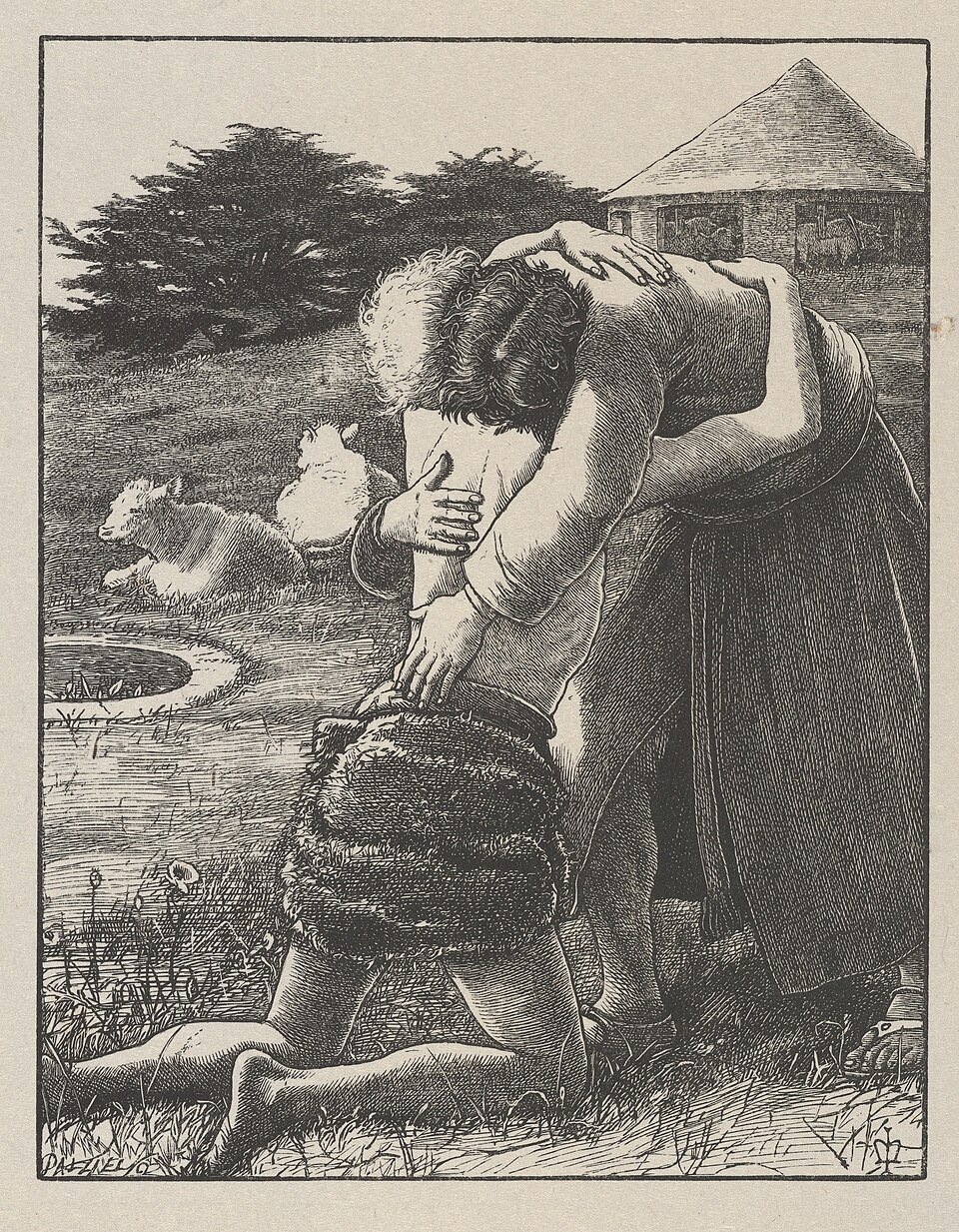
This pattern of earning and transaction, which haunted Jacob, is exactly what Paul addresses in his theology of grace, where the “wages” we earn are death, but the gift we receive is life. Jacob wanted the blessing, but he wanted it on his terms, through his control, by his own ability to perform.
Two Becoming One
Paul’s argument in Romans 11 wasn’t a theological abstraction. Gentile believers are pictured as wild olive shoots grafted into an ancient cultivated tree.1 They don’t create the tree. They don’t own the root. They don’t get to boast about their place in it. Plainly, Paul tells them: “You do not support the root; the root supports you” (Romans 11:18).
It was a brutal paradigm shift for first-century Greco-Romans and Jews trying to walk the Way together. The scandalous claim wasn’t about the established family; it was that wild Gentiles were now being grafted directly into the ancient root of Abraham2. Gentiles were among the nations included in the promise to Abraham to become a “blessing to all nations” (Galatians 3:8), and just a small part of something much older and bigger.3
The Abrahamic story also complicates our instinct to turn lineage into ownership. Ishmael and Esau belong to Abraham’s family story even though the biblical covenant develops through Isaac and Jacob4. And Abraham’s blessing was never meant to terminate with Abraham’s descendants: “all the families of the earth” were to be blessed through him.
Genesis’ story begins with a blessing that is supposed to move outward: the promise is centrifugal. Our religious instincts are often centripetal.
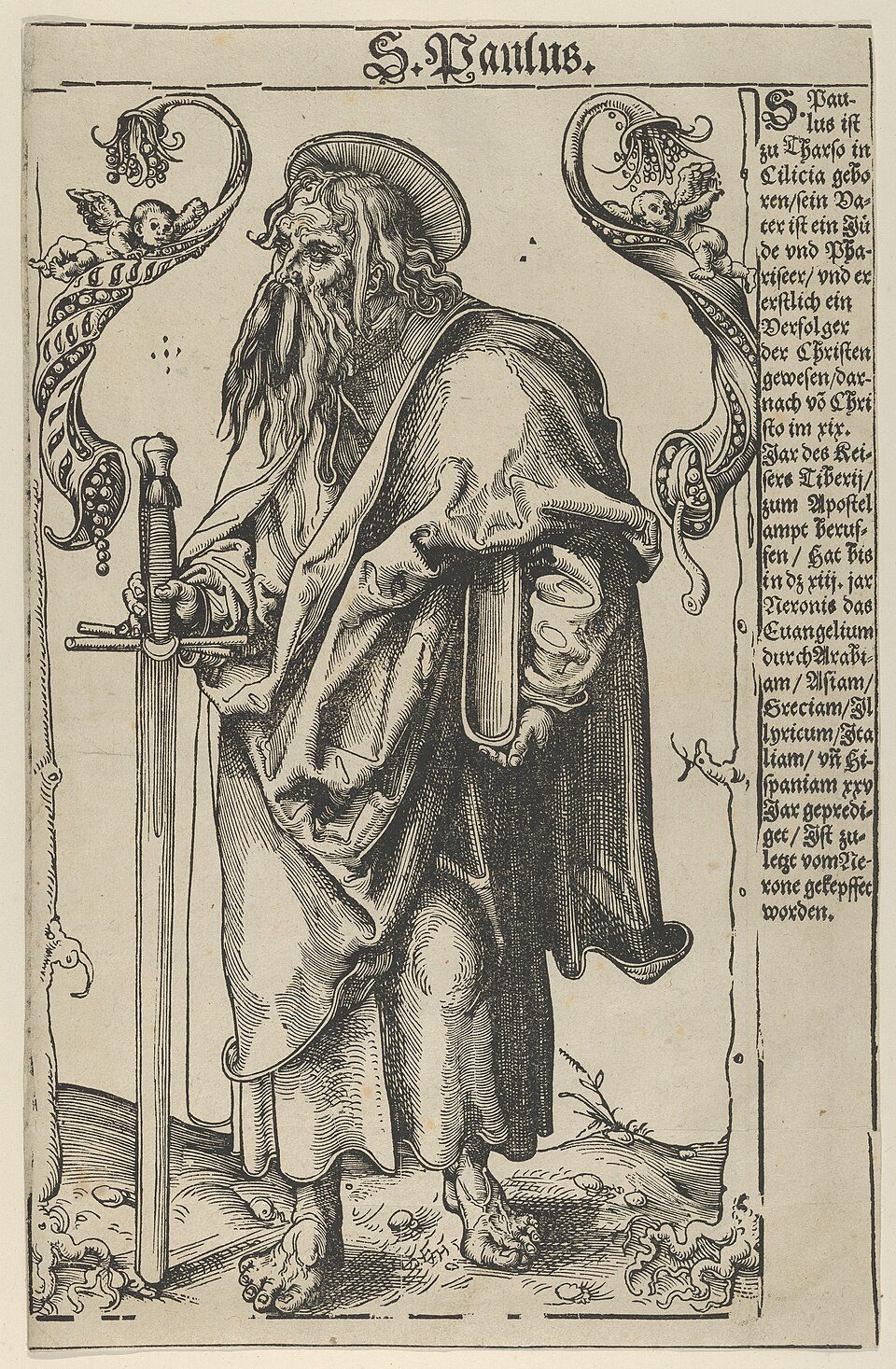
We can debate, argue, and try way too hard to earn an exclusive spot, but it is only by the grace of God and trusting in that root that we have life.
The outsider is a universal human concept—an impulse found across every language, culture, and era. The only difference is semantics. Both Jesus and Paul point toward “the end of Gentiles” as a category (Romans 11:25; Luke 21:24)—not the disappearance of distinct nations or cultures, but the collapse of egoic boundaries that keep people positioned as outsiders to God and one another (Ephesians 2:14–19; Galatians 3:28).
While Jews called outsiders Gentiles, Romans called them barbarians, and Chinese called them Hua-Yi. Different civilizations have repeatedly developed some version of an “us” and a “them.” The terminology changes, while the human impulse is remarkably familiar.
“God’s covenant with Abraham was always designed to be the means of rescuing the world. The problem was that Abraham’s physical descendants had come to regard it as a badge of privilege rather than a mandate for mission.”
— N.T. Wright, Justification: God’s Plan & Paul’s Vision
The End of the Outsider
Jesus came to break down dividing walls so all may be one (Ephesians 2:14ff). The only things that divide humanity are ego and fear.
Today, almost every family and tradition has language and concepts for this truth, which means they also have some tools to work with. Most people are trying their best with what they have.
Life comes only by the grace of God and our trust in that gift. We are all in the same boat—all having sinned and fallen short—driven by those damned egos of ours.
The path through the wilderness isn’t so different for any of us, even if it takes a thousand diverse expressions.
If you’re grasping, fighting the world, and constantly trying to prove yourself, try laying it down and getting right with God by wrestling with Him.
In time, the ego dislocates, God wins anyway, and something like holiness begins to emerge.
“We are saved by grace, we live by grace, and we earn absolutely nothing.”
— Dallas Willard, The Divine Conspiracy
*Updated: 8/19/2026
*Footnotes (& Leftovers)
- Paul’s designation of the Gentiles as a “wild olive tree” acknowledges an uncultivated depth outside Israel’s walls. Even Rome recognized Israel’s antiquity, granting them unique legal exceptions based on age alone. Later, Clement of Alexandria turned that same historical reality back on Western hubris, noting that Greek philosophy derived from far older Eastern sources—even acknowledging those who “obey the precepts of Buddha, whom… they have raised to divine honors” (Stromata 1.15). The wild branches, too, carried traces of an ancient light. ↩︎
- Paul leaves room for understanding Israel not as the root itself, but as natural branches within a much larger, singular tree: “How much more will these, the natural branches, be grafted back into their own olive tree!” (Romans 11:24b). His argument suggests that Israel’s true root ran far deeper than contemporary institutions or physical lineage assumed—anchored in a cosmic covenant of grace that precedes both the Law and the division of nations (cf. Romans 15:12). ↩︎
- Hebrews reaches back even further to Melchizedek, noting he is “without father or mother or genealogy, having neither beginning of days nor end of life, but resembling the Son of God, he continues a priest forever” (Hebrews 7:1–3). The author’s central aim—leveraging David’s psalm—is to demonstrate that a legitimate priesthood can arise entirely outside the Levitical line: “This becomes even more evident when another priest arises in the likeness of Melchizedek” (7:15). Hebrews even argues that Levi effectively paid tithes to Melchizedek, being spiritually present in the loins of his ancestor Abraham (7:9–10). The implication is that Jesus’ priesthood fulfills the inner logic of the Levitical system while belonging to an order that utterly surpasses it. Whatever ancient spiritual traditions or lineages predated Genesis in the city of Salem—whether flowing out from it or birthing its mysterious priesthood—were walking the same Ancient Path. Yet, they remain unrecorded, absorbed, or hidden under labels we no longer recognize. ↩︎
- Jethro, priest of Midian (Exodus 2:16, 3:1), operated completely outside the Levitical line, offering sacrifices and blessing the True God before the Law was given at Sinai (Exodus 18:10–12). Moses married his daughter Zipporah (Exodus 2:21) and integrated Jethro’s organizational wisdom directly into Israel’s governance structure (Exodus 18:13–26). ↩︎