Table of Contents Show
“The current gospel then becomes a ‘gospel of sin management.’ Transformation of life and character is no part of the redemptive message.”
— Dallas Willard
A millennia-long battle has been happening behind pulpits and pews that churchgoers may not be aware of, and maybe some pastors. Fueling seminaries and dividing church history lies one of Christianity’s longest-running questions. It might matter to some.
Christians have argued for centuries over which theory of the cross is correct, partly because the New Testament didn’t reduce Christ’s work to a single metaphor.
Even if you’re not a bible nerd, this exploration will be worth it in the end. At worst, you might walk away with more questions, which is always a good thing.
An Atonement Crash Course
“The Word became flesh, and it is in flesh – his flesh, and then, worryingly, our flesh – that the truth is revealed.”
— N.T. Wright
In Christianity, atonement is the process by which faithful people (i.e., “believers,” pistis in the Greek) are made one with God through Christ. Every Christian, and many non-Christians, “agree” that Jesus died for our sins. The question is, what does “for” mean?
The New Testament describes salvation as a process of reconciliation and transformation, which later schools illuminated from different angles. Each can become distorted when treated as a mutually exclusive mechanism or a tool for ongoing self-deception. The old cliche of At-One-Ment is true not just for the believer but also for the atonement theories. Dividing atonement up and arguing over small differences undermines the process and telos of atonement, of Scripture itself.
In most Protestant traditions and evangelical denominations, the underlying assumption is Penal Substitutionary Atonement (PSA), which teaches that Jesus’ death paid a debt to God that our sins incurred while we are unable to pay it ourselves.
(Here’s an older, longer piece deconstructing PSA.)
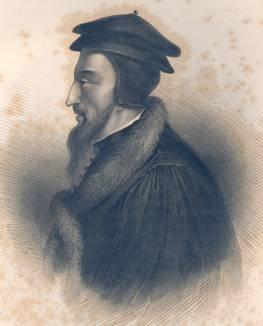
PSA has been around since shortly after Calvin (1509-1564 AD), in which he played an important part in forming it. However, he was far from the only atonement theory architect.
Salvation is not a singular mechanism, but a result. These theories can capture genuine biblical dimensions. Each can be a tool, and all of them were meant to be a process of transformation, not simply intellectual agreement or platform side-taking. Just like how Deconstruction is not a side to take but one part of a process (i.e., descent, shadow work, ego deflation, etc.), so too these theories were never meant to divide, create more enemies, and birth more sin.
Whiteboarding Atonement Theories
“If you present as the gospel what is essentially a theory of the atonement and you say if you accept this theory of the atonement, your sins are forgiven and when you die you will be received into heaven, there is no basis for discipleship.”
— Dallas Willard
During the first few centuries, the Gospel itself was the explanation. While Christianity developed outward, it also began filtering along human lines. As it grew, so did its variants, until eventually, by the fourth century, Christians would kill another over a doctrinal disagreement.
Early Christian writers described Christ’s work using a diverse collection of metaphors: Irenaeus of Lyons (c. 130 AD) saw Jesus as the Second Adam, who retraced humanity’s story, restoring what Adam had broken—a view now known as Recapitulation. Origen of Alexandria (185-253 AD)and later Gregory of Nyssa (372-392 AD) developed versions of the Ransom Theory, understanding Christ’s death as humanity’s liberation from slavery to sin, death, and the devil. Other fathers emphasized Christ’s triumph over those same powers, which modern scholarship calls Christus Victor.
On the Western historical tract, after the reconstitution of the Roman Empire with an agreed-upon Christianity, modern justice concepts had not been developed yet. PSA did not arrive on the scene until a thousand years later. Like other doctrines and orthodoxy, it developed over centuries as Christians wrestled with Scripture, philosophy, culture, and the questions their age posed. PSA became a dominant Western model, in large part, because of its perceived clarity regarding guilt.
In the twelfth century, Peter Abelard (1079–1142 AD), a popular French theologian, argued that the cross fully revealed the love of God, drawing people to repentance through what became known as the Moral Influence theory. These were not yet competing camps so much as different developing biblical lenses emphasizing different aspects of the same mystery.
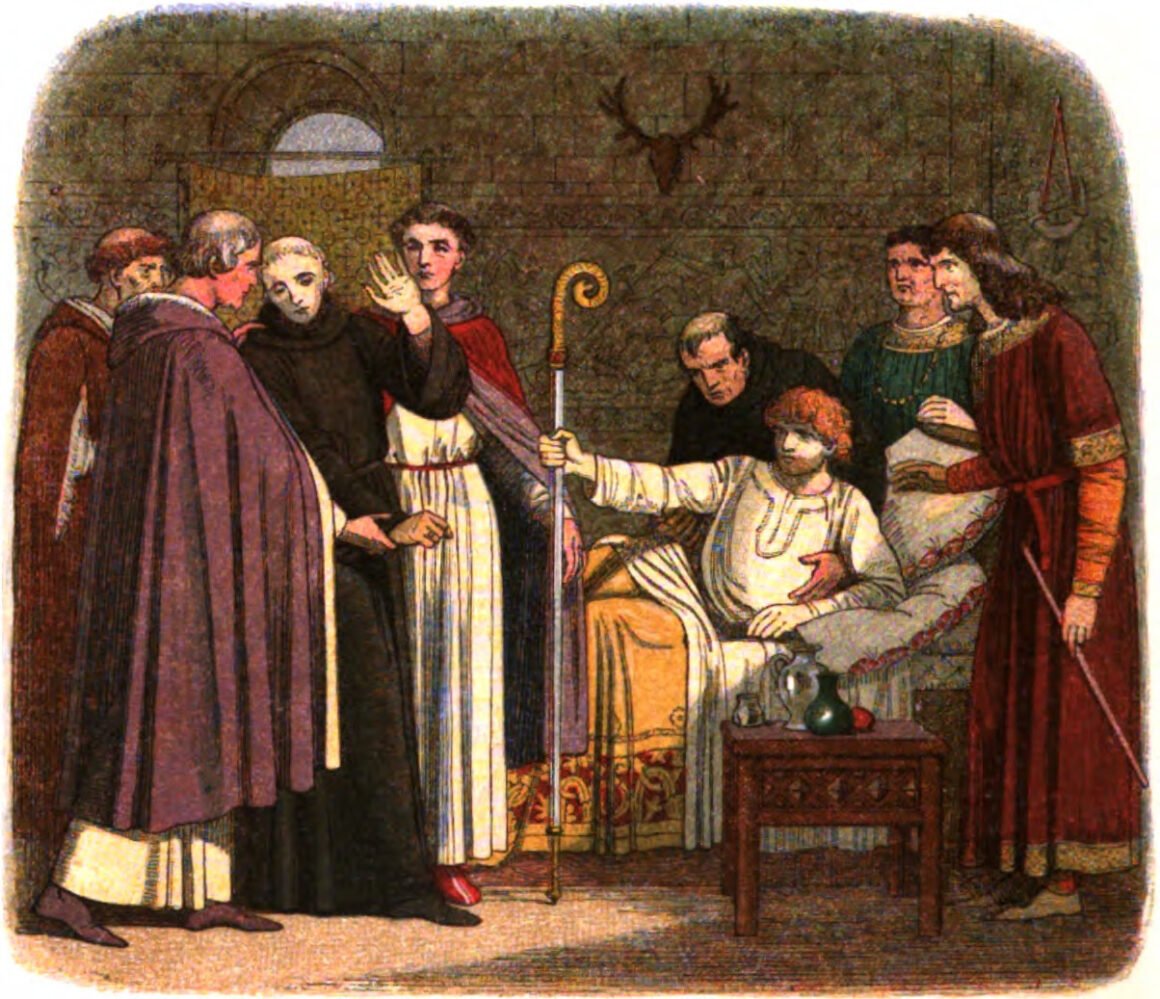
Another atonement player was Anselm of Canterbury (1033–1109 AD). Writing in a feudal society ordered around honor, obligation, and satisfaction, Anselm rejected the then-popular Ransom Theory. If Satan had no rightful claim over humanity, he reasoned, then God owed Satan nothing. The real problem was humanity’s offense against God. Sin had dishonored God and created a debt that humanity could never repay. Only the God-man could offer the satisfaction required to restore that broken relationship.
Anselm’s answer became known as the Satisfaction Theory. It reshaped Western theology, but it was not yet Penal Substitutionary Atonement. His concern was satisfaction, not the Father punishing the Son. Four hundred years later, the Protestant Reformation reframed those same questions through the language of law, judgment, and justification.
Martin Luther emphasized Christ bearing the curse of the Law and the believer’s justification before God. John Calvin integrated Anselm’s satisfaction with a more judicial framework in which Christ bore the penalty due sinners, satisfying divine justice so believers can be declared righteous. In generations after Calvin, Reformed theologians refined their arguments in the Reformed Confessions.
By the seventeenth century, Penal Substitutionary Atonement had become a clearly articulated theological model. It has become, for many Protestants, the default way of understanding the cross.
In The Divine Conspiracy, published in 1998, Dallas Willard critiqued post-2000 Christianity for reducing the Gospel to “sin management,” where faith is merely a legal arrangement for forgiveness rather than a transformative life. He contrasted this with the “Gospel of the Kingdom,” arguing that Jesus offers immediate access to God’s power and calls believers to be active apprentices in daily life.
“If you ask anyone from that 74 percent of Americans who say they have made a commitment to Jesus Christ what the Christian gospel is, you will probably be told that Jesus died to pay for our sins… In this way what is only one theory of the ‘atonement’ is made out to be the whole of the essential message of Jesus.”
— Dallas Willard
A Black Sheep: René Girard & Scapegoats
René Girard came to the New Testament from a different angle. He was a literary critic and anthropologist studying human violence and culture, not a theologian. Through studying literature, he began developing mimetic theory: the idea that human beings do not simply desire things independently, but learn what to desire by imitating others. All human mindsets, emotions, and behaviors can be mimetic.
Human imitation easily turns into rivalry. We do not just copy another’s desires; we compete over them. The same process that creates culture can also create conflict. As rivalries multiply, communities often resolve inner tensions through what Girard called a scapegoat mechanism. A group targets a person or object as the source of its problems, unites against it, and experiences a temporary peace once the victim is expelled or destroyed.
Ancient myths usually told stories from the perspective of the in-crowd. The victim was guilty because everyone believed the victim was guilty. The violence of the community was presented as necessary, even sacred. The scapegoat restored order and averted catastrophe so civilization could continue.
Scripture told a different story.
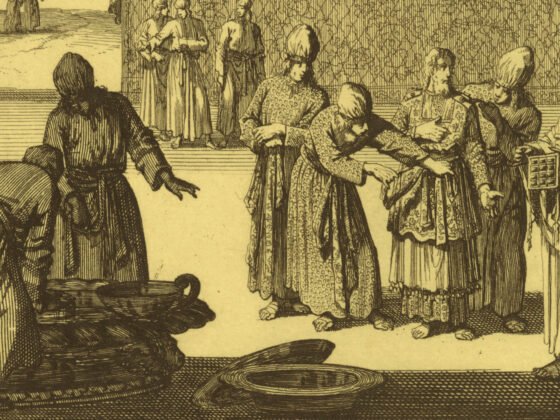
Girard noticed how the Bible unmasked this process from Genesis 1-3 all the way through Jesus. Leviticus 16, the chiastic center of the Torah, made an object lesson out of what humanity does to itself by sinning when, on the Day of Atonement, the climax sacrifice is not one goat but two: one that is driven away and the other sacrificed.
If René didn’t have his model already mapped out, he could have lifted it straight from the pages of the Bible. The Tabernacle system was meant to be a human blessing, not a trap. The notion that the Old Testament contains an angry God is a similar scapegoating mechanism employed by Adam and Eve when they blamed God and each other. Humans have been basically debating different ways of blaming God and each other for most of history. The Gospel put an expiration date on that.
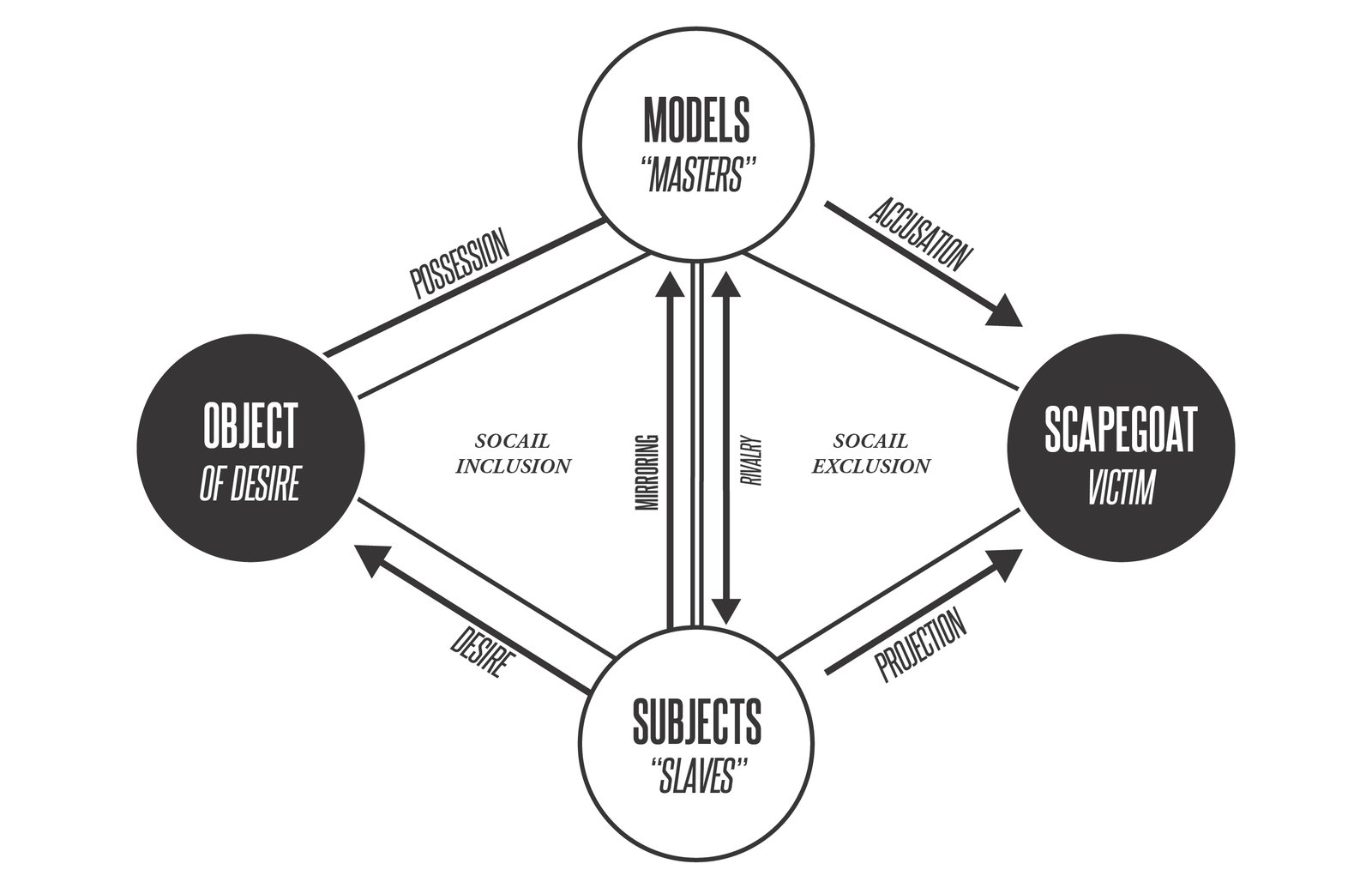
From Genesis onward, the biblical narrative exposed humanity’s tendency to hide, blame, divide, and sacrifice others. Adam and Eve blame each other, the serpent, and God. Cain kills Abel. Israel repeatedly struggles with the temptation to maintain its faithfulness and be priests to outsiders. The prophets continually confront a people who use power, comfort, and greed to avoid confronting their own inner violence.
The New Testament unveiled the pattern and nailed it to a cross (Colossians 1:19-20).
Jesus’ crucifixion was the final scapegoat: an innocent victim condemned by religious leaders, political powers, and crowds. Unlike every previous scapegoat story, though, the sacrifice was not a passive victim, but an active redemptive force.
On a single being, the entire world and its sin fell upon, and yet He remained without sin (1 Peter 2:22–23). He was that which everyone wanted to be, and He showed them the way to become it, while they killed Him to keep the peace. God sided with the victim and the outcast to end victims and outcasts.
The Cross showed how humanity punishes sin. It exposed the entire world’s ego and shadow, taking away its favorite excuse by making it the way to become whole. Humanity has always been tempted to solve problems through avoidance, justification, and distraction. On the Cross, ego and excuses die, so room for forgiveness and love can be born. The Resurrection was God’s declaration that the world is wrong and life awaits on the other side. Christ reveals what humanity is for.
“The diagnosis of the human plight is then not simply that humans have broken God’s moral law, offending and insulting the Creator…
— N.T. Wright
This lawbreaking is a symptom of a much more serious disease.”
Mimes with Mini-Memories
Girard’s work has become influential across Catholic, Orthodox, and Protestant conversations. His work has also influenced marketing, organizational leadership, and social theory. Some have referred to Girard as a modern “church father” because his work uncovered something always present within Scripture.
By exposing the simple mechanics and patterns, the Gospel erased the lines between:
- Master & slave.
- Insider & outsider.
- Victim & abuser.
Jesus did not overcome violence by becoming better at violence. He overcomes it by refusing to return violence with violence. He absorbs hatred without becoming hatred. He tells the truth about sin while extending forgiveness to sinners. In the cross, love and truth meet. And was not the end of the story.
The answer Jesus provided was not simply tolerance or the removal of conflict. Salvation was not a schoolroom concept that we had to pass a test on. It is always a present-tense transformation.
The repeated command to “die to self” is not merely about personal morality (Luke 9:23; cf. 1 Corinthians 15:31). It is the surrender of the ego that constantly needs to justify itself, defend itself, and create enemies to survive. The old self is built around rivalry, comparison, and self-preservation. The new self is formed through surrender, forgiveness, and participation in God’s love.
“Cheap grace is grace without discipleship, grace without the cross, grace without Jesus Christ, living and incarnate.”
— Dietrich Bonhoeffer
A Saint’s Journey
Joseph Campbell’s Hero’s Journey describes a similar pattern in mythology: the old self must descend, confront what it has avoided, and a new, transformed self emerges. The ego must die and shadows confronted so something deeper can be born.
At the end of the journey, the hero returns to the world bearing an “elixir” that restores the community, and the hero reintegrates into a new role. Campbell believed myths contained a universal, archetypal structure. While Campbell’s was a psychological framework, Girard focused on the societal and anthropological roles myths and archetypes play.
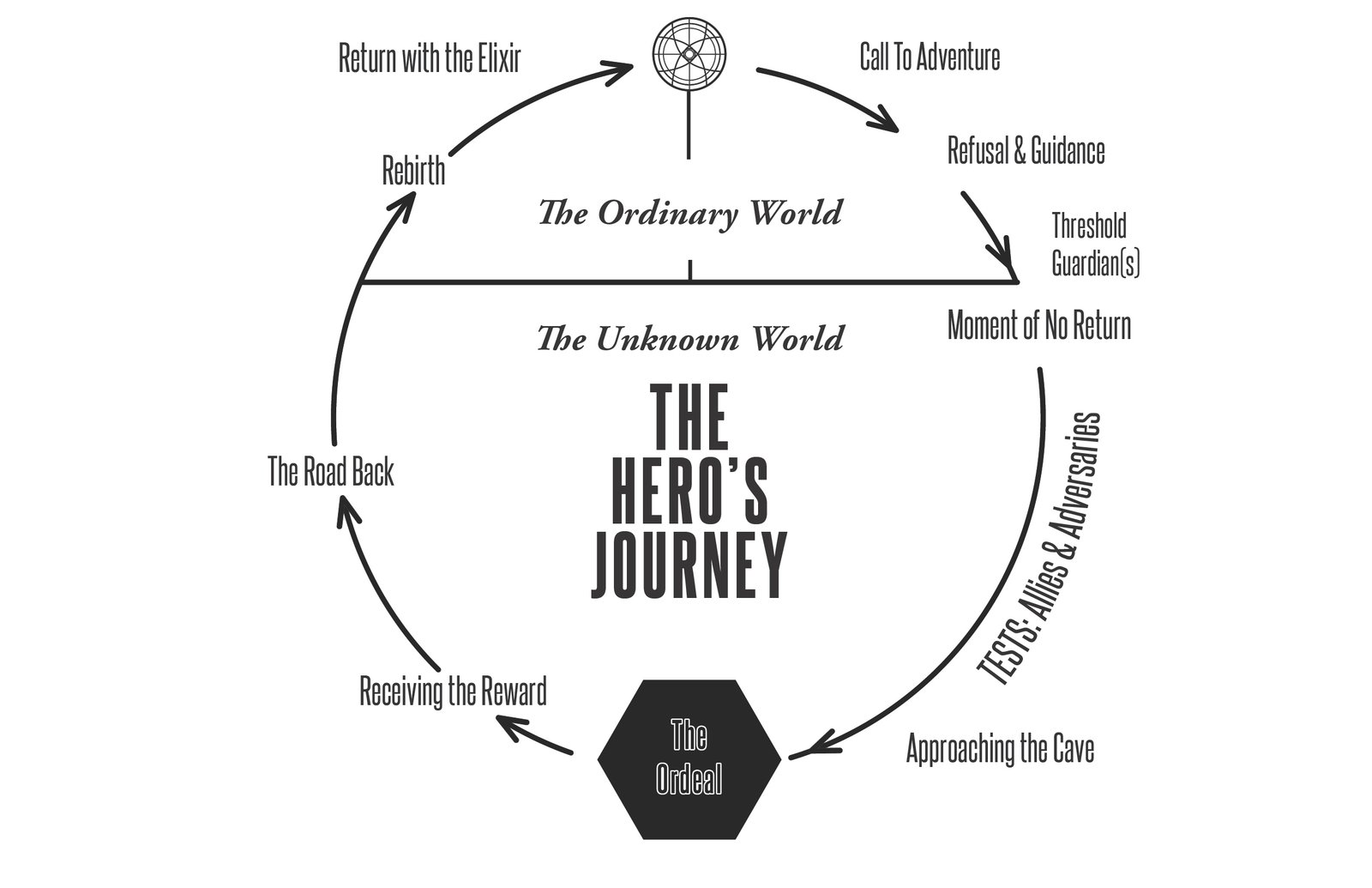
Rather than building on the journey, Girard deconstructed its archetypes further, turning Campbell’s idea inside out. In ancient myths, the community often experiences a magical relief or victory after the scapegoat is killed or banished. Because the violence brought peace, the community looks back at the event and turns it into a sacred narrative. The victim is retroactively transformed into a “hero” or a god who brought the blessing of peace. The narrative is then rewritten from the perspective of the persecutors to hide the community’s collective guilt.
Girard viewed conventional myths and heroic narratives as mechanisms of self-deception instead of blueprints for psychological growth. While the Hero’s Journey celebrates the exceptional individual who saves society, Girard argued society preserves itself by collectively destroying an individual, then inventing a heroic story to cover its tracks.
Jung also argued that societies invent heroic myths because the collective culture needs an archetype of progress and innovation to propel the group forward out of stagnation, albeit with implicit risks. In The Archetypes and the Collective Unconscious, he said, “Tribal lore is always sacred and dangerous… They contain a revelatory knowledge that was originally hidden, and they set forth the secrets of the soul in glorious images.“
For Girard, Campbell was plotting the old hero myth Jesus undid.
For Girard, salvation is the liberation from the cycle of rivalry and violence that has shaped human history. The Spirit helps reveal our patterns and to walk in a new way.
In John’s Gospel, Jesus promised that the Paraclete (the Advocate or Helper, also called the Spirit of Truth) would come after Him. Paraclete literally meant one who walks alongside. Girard argued that the Spirit’s role was to teach what humanity was unaware of. The Spirit would not simply comfort; it would confront and expose humanity so that it could be healed to learn to walk alongside one another (Micah 6:8).
The Cross, therefore, was not a mere transaction but a revelation of the nature of God and humanity, and the invitation to a path by which humanity can finally be made whole.
Girard offered one of the most compelling accounts of how Christ reversed the curse to bring about reconciliation and atonement. He stood on the shoulders of those who had come before him. He died in 2015, while his work continues to be developed and built upon.
“The Paraclete is the universal advocate, the chief defender of all innocent victims, the destroyer of every representation of persecution. He is truly the spirit of truth that dissipates the fog of mythology.”
— René Girard
Back to Beginning Basics
“The matter is quite simple. The Bible is very easy to understand. But we Christians are a bunch of scheming swindlers. We pretend to be unable to understand it because we know very well that the minute we understand it, we must act accordingly. Take any words in the New Testament and forget everything except pledging yourself to act accordingly.”
— Søren Kierkegaard
Genesis begins with communion between God, humanity, and creation before division and death enter the narrative. The Old Testament call is to be one as God is one, or holy as god is holy (1 Peter 1:16). The process of becoming one is called sanctification, which was carried directly over into the New Testament.
In some sense, the model and baseline were all that changed. Jesus became the telos: the fulfillment toward which the story had always been moving. In him, the center of God’s redemptive work shifted from external markers to the transformed human heart, where communion with God could be lived rather than merely anticipated.
The Gospel doesn’t save us by offering a single explanatory formula or social fix: It saves us from such chains.
The process of atonement can not be divided into singular propositions and performative actions. The salvific work and spiritual transformation through the Spirit that produces its fruit can and will pull up everything personal, in our shadows, in our world, and in our own being: mind, heart, body, and soul. And worth it.
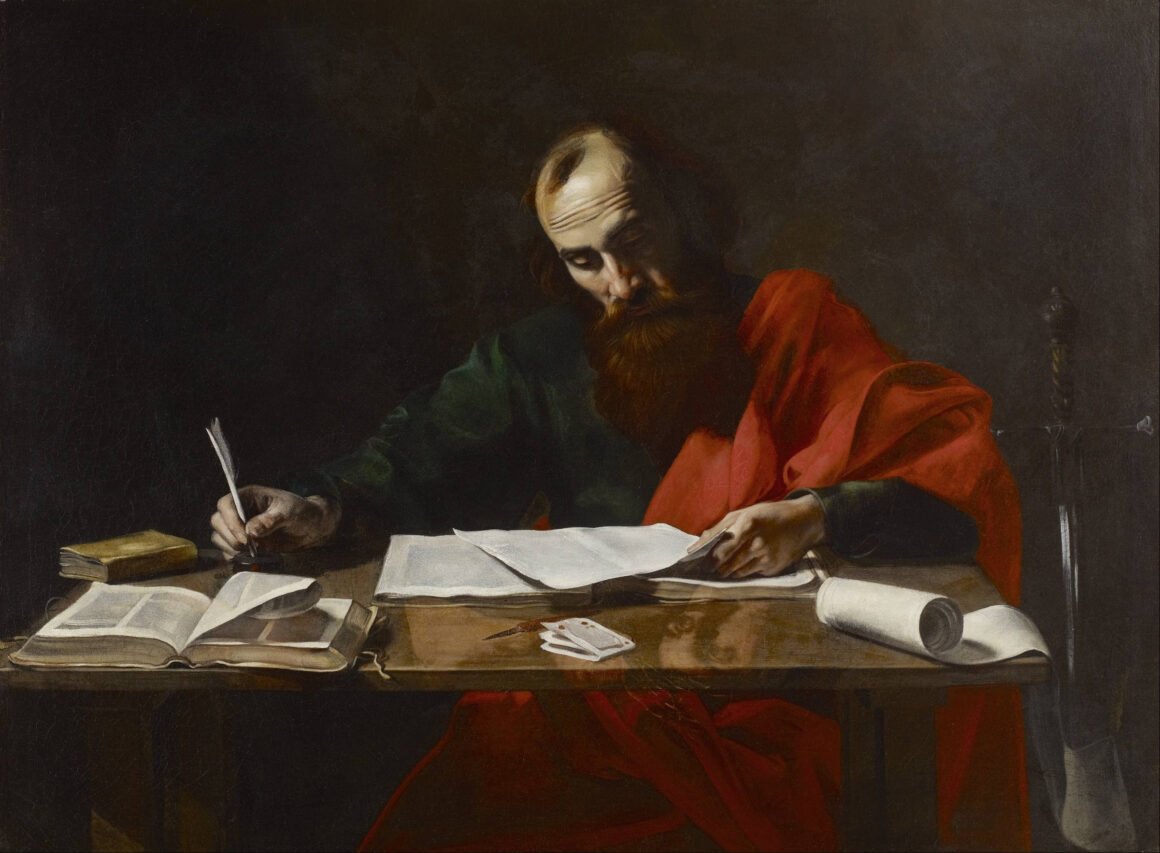
No biblical author writes as though only one metaphor existed. Paul speaks of justification, reconciliation, adoption, redemption, participation, union, and new creation. Hebrews emphasizes the priesthood and sacrifice. John’s Gospel stresses abiding, life, and new birth. Peter emphasizes healing and example.
Atonement is described as:
- Forgiveness (Colossians 2:13–14)
- Freedom (Galatians 5:1)
- Responsibility (2 Corinthians 5:10)
- Victory (Colossians 2:15)
- Participation (Philippians 3:10–11)
- Reconciliation (Colossians 1:19–20)
- Adoption (Romans 8:15–17)
- Sanctification (Hebrews 10:10, 14)
- New Creation (2 Corinthians 5:17)
- Union with Christ and one another (John 15:1–5)
We need not divide Scripture or its invitation. Atonement is an all-in-or-nothing thing (decisive), and a bit-by-bit thing (progressive). In truth, it’s rather something simple that humans like to overcomplicate because it’s difficult.
The Gospel reconciles what human beings have fragmented—God and humanity, self and neighbor, heaven and earth, inner and outer life. Different atonement models are best understood as complementary windows into that reconciling work.
Sanctification can happen in sudden U-turns, but even those are trajectory turns that simply put us on the path we’ve been avoiding or maybe grown unfamiliar with (*cough* discipleship). It can be in trudging and practicing principles we’re learning along the way (*cough*). It can be in noticing and serving the other. It can be in the smallest conversations where an apology is made and a relationship reconciled. It can be in the great moments of selling everything we wasted our lives on to finally do something good with. It can be in a lot of things. And it’s about one thing: love.
The result of the Gospel is that lives are changed here and now. It just takes happening.
Christians have ironically spent centuries dividing over a doctrine whose purpose was reconciliation. We can get really distracted by reductive fixes, narcissism of small differences, and intellectual debates, when all we ever had to do was just trust Jesus and go through with what He taught, as plainly laid out in Scripture.
“We get a totally different picture of salvation, faith, and forgiveness if we regard having life from the kingdom of the heavens now—the eternal kind of life—as the target.”
— Dallas Willard
Updated: 7/12/2026