Table of Contents Show
While writing my book, a conclusion came into sight that brought tools, implications, and direction.
One of those was what I called the 1-to-1 Relationship.
It is learning to encounter reality without changing it into something I needed it to be—and then allowing that encounter to change how I participate in the world. At the time, there wasn’t a better word for what I was exploring. I understood it well enough to practice it, and it showed up in surprising ways.
Rather than explain it, I’d like to share my experience with it so far.
“It’s about practising the habits of heart and mind and life which will form your character.”
— N. T. Wright
Encountering Reality
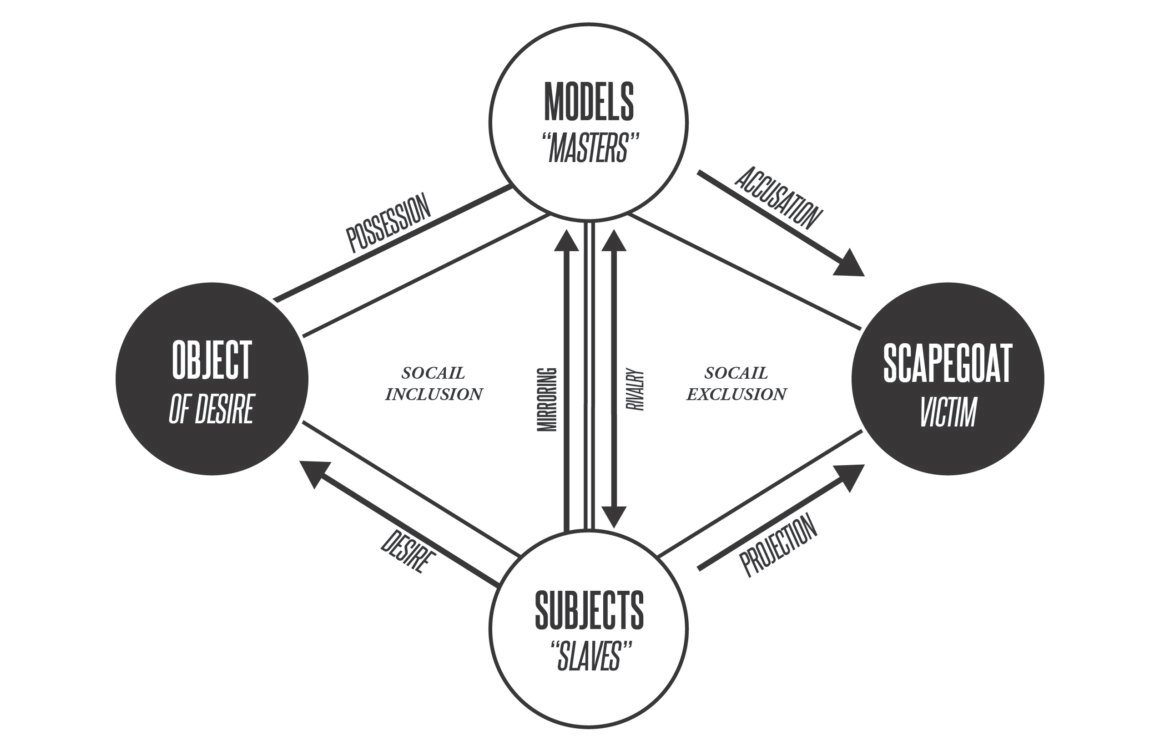
As an example, I noticed that I could use the mimetic triangle to be aware of ruminations. If and when I can catch one, if I can hold it long enough, I can stop treating the rumination as an external problem and bring its various parts into conscious awareness (Psalm 139:23–24). Rather than talking in imaginary courtrooms or stressing and bouncing around in logical loops, I have this option of pausing and noticing long enough to let it fall apart into its honest parts.
Another place has been in worship and meditation. Attempting to clear myself away enough for a reverent and exposed 1-to-1 connection with God has been one of the most surprising aspects of my journey.
If you’ve ever read Job and are familiar with when God finally shows up on the scene, and imagined what it must have been like for Job to have been drilled with question after question from God, after he had lost everything and sat in miserable health, then you’ve wondered what a 1-to-1 connection with God must be like (Job 38–42).
The 1-to-1 connection is one without assumptions, conditions, or expectations. God is not merely interested in hearing how much we know about Him. That gets annoying. He wants to know us too. When God is in the room, there is no room to hide internal monologue or performance.
It is not a singular check-box, nor is it limited to just two entities in a room. The 1-to-1 is about living in a naked, honest posture toward every dimension of existence—from individual thoughts and community, habits and family, to the web of Creation I’m caught up in. It carries a distinct calling: to participate in and give life back to the parts of our journey that have given us life.
Life becomes a dance of “ones” that I am but one of.
I can enter that space, sometimes only for a moment, and when I notice that I’ve left it, I can return. This is not about either ego or shame: God’s light will shine through them, and they will wither in it. His love holds space for our sins to be cleansed.
“Your true self is the Divine Indwelling, the Holy Spirit within us. The true self is precisely the divine part of us that is great enough, deep enough, gracious enough to fully accept the human part of us.”
— Richard Rohr
All My Relations
The first time I noticed someone saying “All My Relations” was at the first sweat lodge I experienced. An elder said it like a mantra, and it immediately rang my soul strings. That sweat taught me how to pray more than bible college ever could have. Before entering, a regular leaned over to me and whispered, “Your horns are looking a little long, and your tail is poking out.” I knew what he meant and would soon learn how he knew it.
While in there, I was praying for my children with a broken heart and carrying a lot of baggage from a past harmful relationship. I was at another point in my life of being sick of myself, and wanted to come before the Divine (cf. Psalm 51:17). While praying, I noticed the things that would come up instead of my prayers: the distractions, insecurities, and random stories that were not me praying for my kids. As I kept working through them and pressing closer, it was miserable to see how much bullshit I carried and spun as a one-man band. At one point, I was face down bawling over the self-centeredness.
I don’t know the full depths of Native teachings around “All My Relations,” but it taught me something that day. Its truth also pulses through Christian Scripture. Since then, I’ve learned a lot about my horns and tail, and can notice more quickly when they need a trimming. While last year felt like executing the old serpent archetype, this year has felt like God burning everything from the inside out.
This was a 1-to-1 experience, and worship, meditation, and everyday work and relationships can be it. Walking away from the sweat, I realized I didn’t discover anything new at all, but had just tasted the depths of ancient wisdom. “All My Relations” applies to much more than our immediate circles. It includes God, Creation, relatives and ancestors, neighbors, teachings, and habits. “All my relations” is perhaps the most beautiful expression of “To God be the Glory” I’ve heard.

Purging & Illumination
It doesn’t make me behave differently, but it can be hard to function the same way as before. Entering into a sacred 1-to-1 space with God illuminates and purges (cf. Malachi 3:2–3). Healing always requires both removal and using that healing. To hear God’s voice, I must be able to remain still. Then, I must follow through when the moment is done and walk in a new way if anything is going to stick.
Over time, these moments become deeper, more spacious, more available, more normal, and more a part of life. In time, they begin to bear the fruit of the Spirit. I still wrestle with pride, and am much more humble after being on the floor of my apartment, face to face with my arrogance before God, and having nowhere to turn to, hide, or point fingers (Job 42:5–6).
This is a dance with the shadow and ego, learning to surrender before the Divine and beginning to break their control. There’s been a surprising number of topics from recovery and personal practice that relate to it, like Internal Family Systems, breathing and visualization techniques, and having practiced enough meditation to be more present and hold space. They were rather simple, too; they just took practice.
Such tools and many more are available in the world. The 12 steps of AA, and any good counselor, should also be able to help an individual build a better 1-to-1 relationship with Reality. Principles and realities discovered in therapy should carry over with us until therapy is no longer needed. The same applies here.
“Spiritual disciplines are not primarily for the solving of behavioral problems, though that is one of their effects.”
— Dallas Willard
The Way God Is Making
God is not interested in having a codependent, insecure, or performative relationship with us. He is interested in Divine Image bearers living in love, truth, and freedom, participating and co-creating in Creation. The biblical image of the world’s ending scene, never mind all that came before it, is humanity redeemed (Revelation 21-22). The main mode God has used has been by ringing that heavenly call into the present, down here on Earth where it always belonged. His Spirit works with and through people, and Jesus was clear that love would be the way people would know the truth.

When I applied the 1-to-1 concept to my life, it was clear that everything had conditions, expectations, and a lot more baggage than I cared to admit then. Today, I’m still struggling with nicotine, discipline, and many things. I hate it. But I’ve been able to accept them as they are, which was big progress for me. In the meantime, God has kept working on a lot of other things that were buried so deep it took a thousand tiny rectal extractions.
I’m learning more about being content alone while “chopping wood and carrying water.” I’m still a long way off; I can be too arrogant, selfish, and undisciplined, and other issues are on the chopping block. This concept, which is no mere concept, has been one of those things I wanted to forget but couldn’t. It keeps showing me more, and when I do lose sight of it in one area, things go awry. It has helped me worship, pray, quiet my mind, and finally be able to serve authentically.
In essence, it is making our means match our ends: doing the thing, or not doing the thing, for the sake of its own sake. The way we pursue an end either participates in that end or contradicts it. Ethics debates often get reduced to what ends justify the means, along with the black-and-white of semantics and opinion. There is another option beyond the dichotomy: remove the mind games, accept our position in the world, and just do what is good because we want that good.
“A discipline is an activity within our power—something we can do—which brings us to a point where we can do what we at present cannot do by direct effort.”
— Dallas Willard
Learning To Live
When I learned this, I didn’t have enough maturity, self-control, and honesty to apply it to everything at once. Still don’t. While we can have as much change as we can stomach, we have to be aware of the need in the first place, and then it can feel like a part of us is dying when we do change (cf. Romans 6:6–11; Galatians 2:20). I wanted to encounter each thing as it actually is, rather than relating to it through the distortions, projections, compulsions, expectations, fears, fantasies, and scripts I dragged along.

1-to-1 connections also kept showing up in my inner work, with parts of myself. If you’ve ever gone back and forth with yourself in your mind, been sick and tired of yourself, or felt like an imposter, there are parts of yourself in conflict with each other. As time has progressed, my relationship with my body, weaknesses, strengths, and history have noticeably improved.
This is no mere flaw but perhaps partly a built-in predisposition of our neurobiology. Our two hemispheres function differently, and their integration matters. If one mode of attention becomes disproportionately dominant, our relationship with ourselves and the world can become off-kilter. When we’re not in right relationship with ourselves, we’re not in right relationship with anything.
There’s plenty of precedent found in books like Thinking Fast & Slow, The Master & His Emissary, Return to the Brain of Eden, and The Body Keeps the Score.
It also implies that it is remedial. The science was there, the Scripture spoke to it, and the only thing left for me to do was to get on with it.
“Spiritual formation in Christ transforms your embodied will.”
— Dallas Willard
Encounter Precedes Transformation
To live this way has meant learning to encounter the world as it is, to face myself, practice honest apologies, learn authenticity, be more teachable, work better, and a litany of other things. It still mostly feels like I paint with mistakes. Spiritual disciplines have pulled up and out many things I didn’t want to acknowledge and let go of: a breathtaking list.
Rather than having ideas about forgiveness and praise, Jesus made me experience them. Instead of debating atonement and pneumatology (the study of the Spirit), God dragged me through them until I could crawl out and let the cess drip off.
The way of the Gospel is not a concept to agree or disagree with. That’s almost irrelevant. The work of Christianity is spiritual formation: learning to be loving and truthful.
Everything else is just footnotes and semantics.