Table of Contents Show
“In the biblical understanding, knowledge of God does not come through inference alone, but through participation in God’s action. One comes to know by entering into the reality being revealed.”
— Dallas Willard
This audio is class #2 of 3, looking at theGospel of John, taught last Sunday as part of the Bible in Context series, with slides and a written summary below. Early on, we briefly review the first class on Genesis. It’s an overview, so we skip plenty, like John’s second ending.

The focus of this class was John’s context, themes, opening movement, especially chapters 1–4, and how deliberately John reframes Jewish covenant language, identity, and expectation. We spend time with the wedding at Cana, Nicodemus, and the Samaritan woman at the well. Rather than novelty or hidden codes, we learned to read John as a late, reflective Jewish text that assumes its audience already knew the Synoptic Gospels and other Scriptures, and how symbolism works.
This class was taught at Sacred Ally. Sacred Ally is a contemplative, spiritually grounded space that serves cocoa drinks, offers eastern services, and has a large meeting space. I wanted to teach this class there intentionally. The building itself used to be a church, and I remember being in a meeting of local pastors there. Teaching the Bible there felt like a return, and also a reframing.
Methodologically, this class draws on:
- the Hebrew Bible as John’s primary symbolic world
- Greco-Roman Religions
- Second Temple Jewish thought
- Greco-Roman political theology (especially emperor cult and “good news” language)
- Narrative Theology rather than proof-texting
- Interdisciplinary scholarship (including N.T. Wright, David Wead, Kenneth Dailey, Raymond Brown, Richard Bauckham, and others), alongside long-form engagement with the text itself
This isn’t a devotional talk. It’s an attempt to destigmatize the Bible so it can speak clearly, so we can think carefully and honestly about what John is actually doing: why he includes what he includes, why he omits what others emphasize, and how his Gospel reshapes ideas like kingdom, logos, glory, and truth.
The class slides are included as a PDF with my personal notes, where we skipped some things. The written draft included here expands and sharpens some of the themes explored in class discussions. Together, the audio and text are intended to be explored slowly, critically, and without pressure to reach tidy conclusions. It’s more of an invitation to go learn more about what the meanings are of such things, especially for you and your neighborhood.
Next week’s class will bring these threads forward into Revelation: Ego, Empire, and what the coming of the Son of Man is.
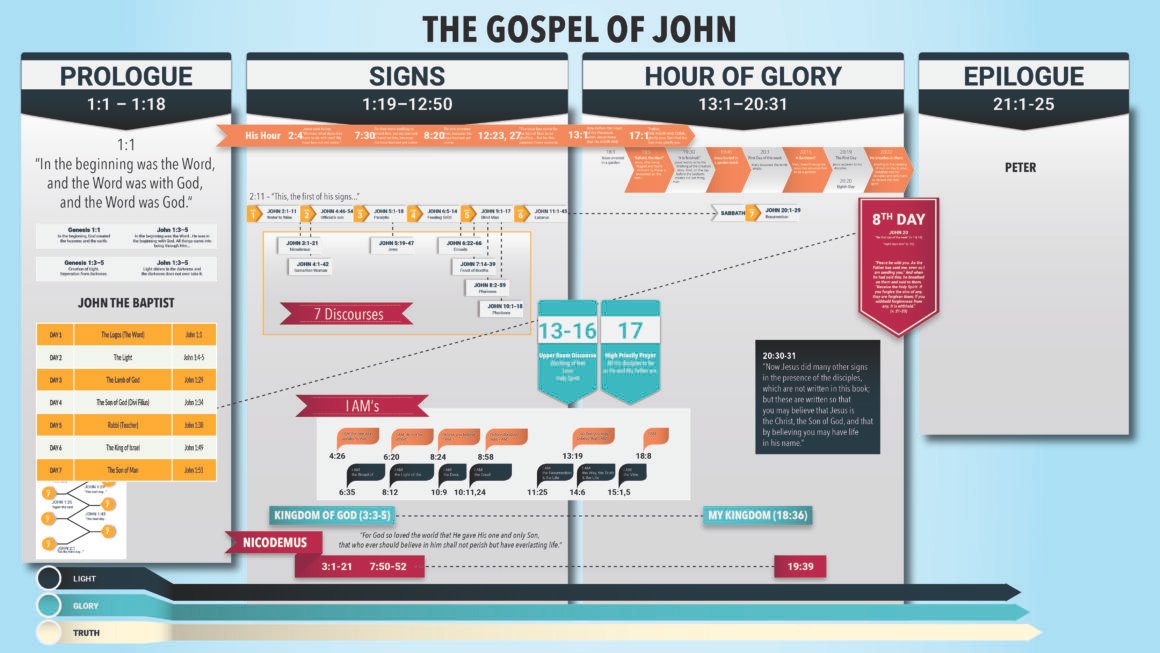
Slides (w/ Presenter Notes)
Genesis to John: The Good News Re-Told
There are two simple ways people try to make sense of the Bible: build a system or tell a story. Systematic theology hands us blueprints, rules, and tidy categories. Narrative theology hands us characters, scenes, and a plot that shapes the soul. Both matter and both fail when they become idols. My aim here is not to decorate doctrine or to invent a tidy system. It’s to read the Gospel of John with its own grain, through the eyes of Genesis, through the political noise of the Roman world, and through the Jewish faith that birthed it, and to show how John reframes the whole enterprise of Pax Romana and salvation so that the cross is not an afterthought but the incandescent center of God’s revelation.
Genesis: A Prototype of Creation, Shame, and Blessing
Genesis is not simply a Jewish origin story. It is a ritual architecture: sevenfold structures, repetitions in sevens and threes that teach a perceiving reader how the world holds together. The first chapter’s careful counts, words, and nouns grouped into sevens, are not literary trivia. They teach that creation is intentional, good, blessed, and ultimately oriented toward Sabbath rest (Gen 2:1–3). Genesis 2–4 introduces the psycho-spiritual dynamics: nakedness and shame, the serpent, the rupture of the relationship, and the exile of the human. Joseph’s family’s long narrative, with its final turn toward forgiveness in Gen 50, shows that coherence, the resolution of enmity through mercy, is possible, but it takes time, humility, and a refusal to usurp God’s place.
Read Genesis as a formation text. It trains perception: what holiness is, what covenantal fidelity looks like, and how human rupture is both personal (shame, ego) and structural (power, violence, kingship). Those motifs will reappear in John, and John rearranges them.
A Jewish Mystic Reframing Identity and Politics
John writes later, from Asia Minor, after the Synoptics, the first three gospels so named because they look the same, have already set a certain course, and Christianity has already broken out of the Levant. There’s evidence of Christian house churches in Rome, the city of concrete and temples, by the time John writes. His project was not to impersonate those gospels. Instead, John built on their existing work and stood on the shoulders of all his brothers’ and sisters’ work.
John gratefully recasts the story theologically and retrospectively (source: David Wead, The Literary Devices in John’s Gospel): Jesus is presented as the Logos (the Word), the light that dawns into darkness, the life of humanity, the true vine, the Lamb, and finally the Son of Man who inaugurates a new creation. Beginning with the unmistakable echo of Genesis, “In the beginning was the Word…” (v 1:1), John overlays Genesis’ creation frame on the person and work of Jesus through the rest of his Gospel. The Word is creator, life, and light; the Gospel is a story of new creation. The Resurrection is the final sign we are dared to follow through.
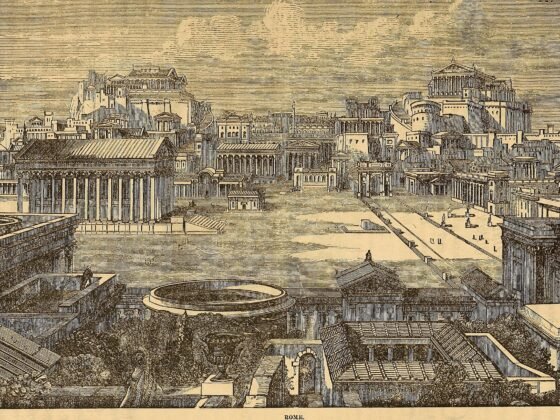
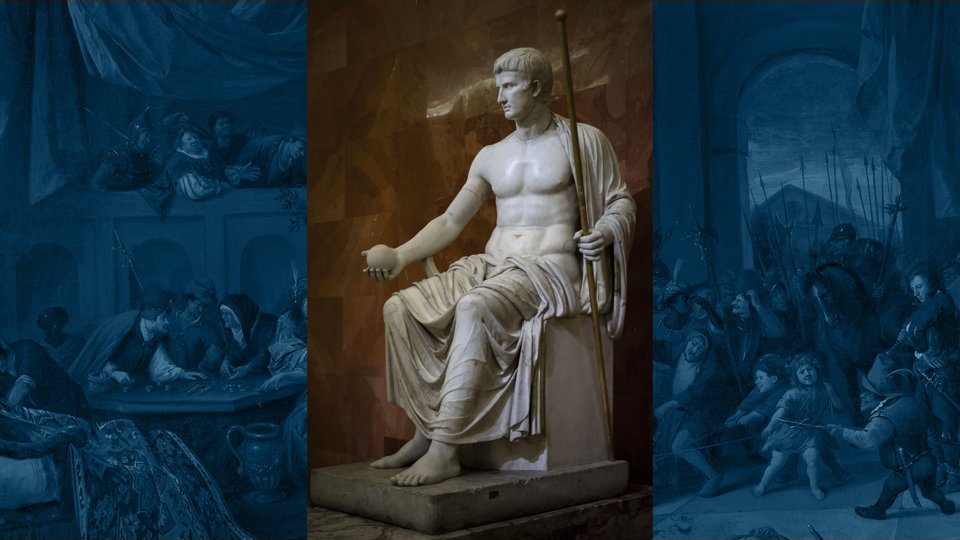
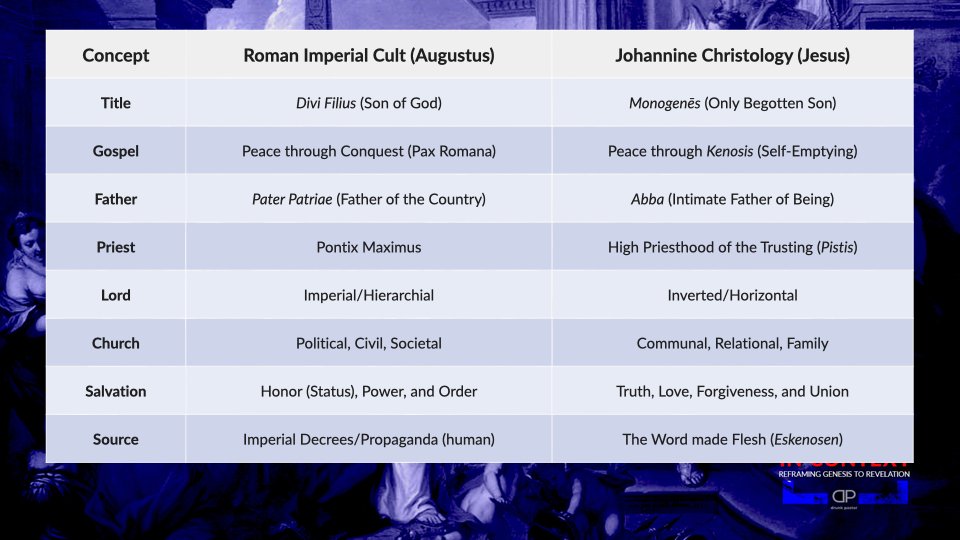
John was living inside a world where emperors were gods, where apotheosis (the making-divine-of-a-human) was a political theology that demanded knees to bend. Statues, inscriptions, and civic religion in Asia Minor proclaimed Caesar as savior and guarantor of order. Into that empire, John writes an inversion: the Son is not apotheosized after death; his hour of glorification is the cross. Where the empire taught power and honor through domination, John teaches the Kingdom of God through kenosis, the self-emptying that reveals God.
John’s “pistis” is not mere intellectual assent; it’s trust that changes ontology. For Jews, faith was communal and covenantal. In Graeco-Roman usage, pistis was trust and a relational dynamic, used among friends, business partnerships, and marriage. In other words, it meant “trust” rather than intellectual agreement, which anyone can fake. Pistis was also often used for allegiance or loyalty to Caesar and Rome; for John, faith is ontological and a share of the life he put ink to. That is why belief in John is not chiefly about right doctrine or tackling their existing culture wars1, but about a right way of being (“The kingdom is within you,” John intimates while challenging us to answer Pilate’s question, “What is Truth?” ourselves).
The Greco-Roman pressure and Johannine counter-narrative
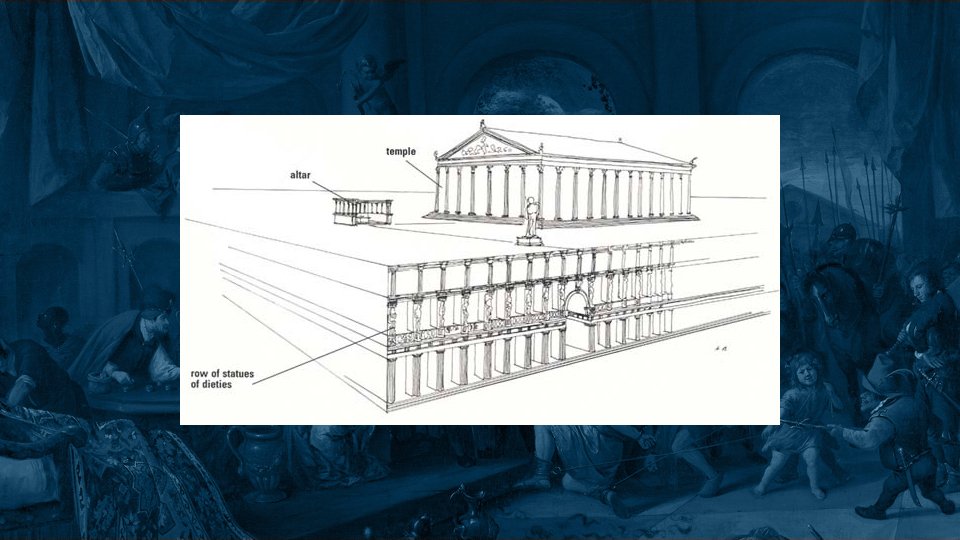
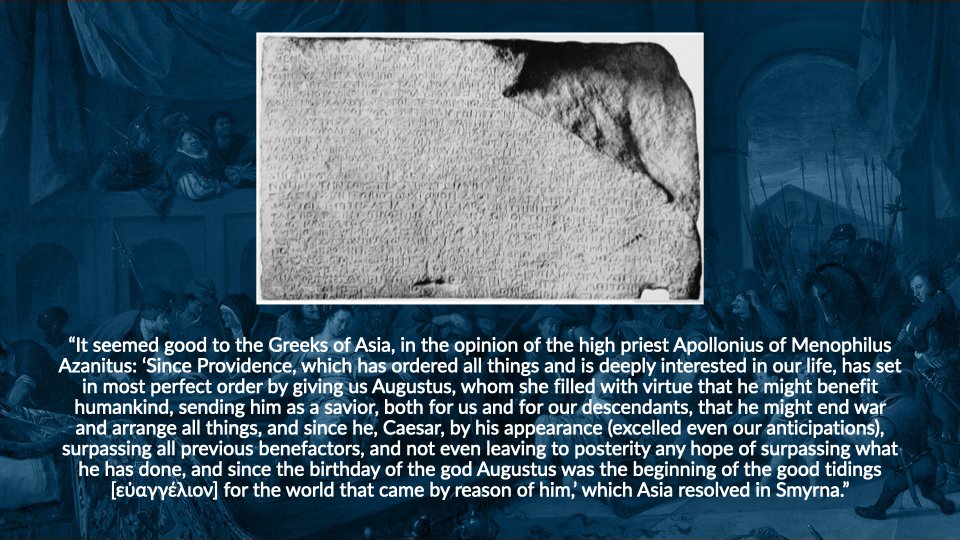
The world John writes into was saturated with religious-political propaganda. The Priene inscription praising Augustus, calling his birth the beginning of the “good news” (εὐαγγέλιον) for the world. Emperors claimed divine sonship (i.e., divine right of kings) and salvation by conquest. John answers this claim not by mimicking imperial piety but by subverting it: a different Son, a different Glory, and a different Love.
Where Roman religion ties divinity to conquest, genealogy, and the imperial cult, John redefines sonship and glory through vulnerability, forgiveness, and the cross. Jesus’ “hour,” his moment of definitive revelation, occurs precisely when empire thinks it has won. The cross is not defeat followed by posthumous deification. Rather, it is God’s self-revelation: dying to self so the serpent of shame is transformed into a crown of eternal life.
That inversion was ontological theology that threatened political theology. John knew he was playing with fire. His Gospel refused imperial categories of honor and reoriented sacred communities around forgiveness, love, and the family-like “churches” John imagined.
Structure and symbolism: John’s sevenfold movement
“John has written his Gospel in such a way as to make it clear that what he is describing is nothing less than the launching of God’s new creation, the renewal of the world through the work of Jesus. The signs are not simply evidences to be weighed, but events through which the new creation is already breaking in.“
— N. T. Wright
John was not haphazard. The Gospel’s architecture mirrors creation and then adds another week and an eighth day, the resurrection, and inaugurates a New Creation. As an insulting reduction of his movement, consider:
- Day 1 → The Logos (John 1:1): the Word who creates, the new “in the beginning.”
- Day 2 → The Light (John 1:4–5): breaking into darkness.
- Day 3 → The Lamb (John 1:29): substitution, sacrificial meaning.
- Day 4 → The Son of God (John 1:34): revelation of identity.
- Day 5 → The Rabbi/Teacher (John 1:38): instruction, formation.
- Day 6 → The King of Israel (John 1:49): messianic recognition.
- Day 7 → The Son of Man (John 1:51): the figure who links Danielic authority with paradoxical service.
- 7 Signs
- 7 Dialogues (w/ an entirely different Upper Room Discourse)
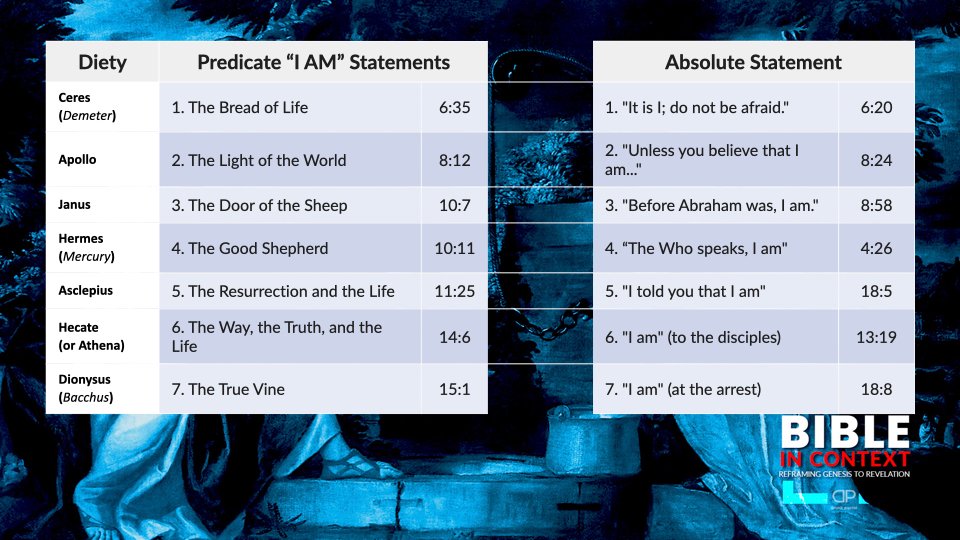
- 7 + 7 “I am” Statements: There’s a second set. See the slides for a table.
- Another Week
- The 8th Day → Resurrection (John 20): A new creation beyond the Sabbath initiated by the passing on of the Holy Spirit with the subverting command to forgive what’s on Earth so it will be forgiven in Heaven.
John’s use of seven, from days and titles to signs and “I AM” sayings, functions like Genesis’ days: it maps a created, ordered world and shows how that ordering is renewed in Christ. The Gospel’s seven signs (from Cana’s water-to-wine through the raising of Lazarus) echo Old Testament prophetic deeds and the wider repertoire of miracle-narratives in antiquity, but John recasts those motifs to disclose Jesus’ identity and mission rather than to offer forensic proof. The signs, therefore, operate theologically and narratively as sacramental models: when the Word acts, creation responds in faith, and the reader is invited into that re-ordered life.
John’s “I AM” sayings (echoing the divine “I AM” of Moses’ encounter with God as well as Genesis 2:1-3) are another axis of spiritual formation: bread, light, door, shepherd, resurrection, way-truth-life, and true vine are all cast in the frame of sanctification. We are called to be one with the Father, a unique phrase in John’s Gospel, as Jesus was, and then sent into the world as Jesus was. Each “I AM” is a claim not to metaphysical trivia but of existential reorientation. Whatever Jesus was, He told his disciples that they needed to be too. To have faith in Jesus’ “I am the bread of life” is to embody a life-economy where being is fed by union, not by domination.
The Cross: Revelation, not Failure
The first half of John is often referred to as the Book of Signs. The hammer-blow of Johannine theology was the cross as the Hour of Glory, which makes up the back half of John. The Passion narrative, Last Supper, and Resurrection are told from a different angle than the Synoptics, with John looking back through them and his experience as an apostle for the last several decades.
Roman thought would expect glory to be granted after victory or conquest. The cross is where God lifts the curtain and tears the veil. Humanity is exposed and, as a result, God is finally seen through the egoic crud built up over generations. The Son of Man must be “lifted up” so that “whoever [trusts] in him may have eternal life” (John 3:14–15). The paradox is theological and moral: God shows that power is perfected in weakness, that leadership is realized in service, that justice is enacted through forgiveness.
This is not sentimental consolation. It is a hard anthropology and an honest spiritual transformation. The New Creation requires kenosis: ego-death, the letting-go of dominance, the refusal to claim divine prerogative (as Joseph’s speech in Genesis 50 models: “Am I in the place of God?”). John’s final chapters echo Joseph’s wisdom: forgiveness resolves sin and the tension between good and evil, and reconciliation is the telos. When a human breathes the Spirit, forgives, and releases, the creation-order moves toward wholeness. It’s magical.
Faith As Ontological Trust
Pistis, as trust, is both personal and communal. For John, to “believe” is to be enrolled in a social formation that opposes empire. Discovering Jesus as the true Son of Man reconstitutes identity: nationality, status hierarchies, family baggage, and shame economies are reoriented toward mutual belonging.
Nicodemus arrives at night: a Jewish man of status, confused by the demand for rebirth. The Samaritan woman meets Jesus midday: a social exile who becomes an evangelist. Then, the Resurrected Jesus first appears to Mary before his own male apostles. John’s theology loves the periphery because that’s where the new creation begins to leak into the world.
Theologically, the promise is not private bliss. It is a reordering of human relationships. The kingdom is near, present in acts of love, forgiveness, and goodness, and in a community that breathes and walks in the Spirit.
How This Helps
The ancient world and our world share patterns: figures shouting their identity, idolatry of power, culture wars, narratives that justify violence, and religiosities that domesticate God into political utility. John refuses domestication. The Cross exposes the lie that power, or group certainty, equals salvation. The Resurrection inaugurates a politics of reconciliation that begins with individuals but must not remain private, connected to the Vine. It names a formation, liturgical, ethical, and social, that trains people away from shame, into forgiveness and life.
There’s an edge here: the Gospel is not a psychological bandage for anxieties. It is a formation program for the human person: identity cleared of false claims, reconnection to others, and a willingness to live into vulnerability. Joseph’s example in Genesis, refusing to put himself in God’s place and offering blessing instead of vengeance, is the ethic John dramatizes in the passion and the post-resurrection commission (John 20:21–23). Forgiveness is the engine of reconciliation and of God’s new world.
Practical contours for teaching and formation
If we teach John from Genesis forward, a few commitments help preserve what the Gospel is actually doing:
- Teach narratively, not defensively: John assumes questions, tension, and ambiguity. Reading John’s Gospel as a story rather than a system gives people a faithful, scriptural basis to think, wrestle, and stay engaged without fear or pretense. This invites Science and Spirit (i.e., “Spirit and Truth” John 4:24).
- Frame belief as formation, not agreement: Pistis in John is learned trust that reshapes how a person lives, relates, and forgives. The goal is not correct prepositions and societal norms, but a re-formed way of being human within Creation.
- Read the signs as meaning-making, not spectacle: The signs reveal how life is reordered, through abundance, healing, restoration, and reversal of shame, not as proofs to win arguments, but as windows into a different economy of life.
- Hold anthropology and healing together: Genesis names how humans fracture through shame, grasping, and power. John shows what restores them. Neither works alone; together they make the Bible intelligible and honest.
- Expect new “Gentiles” in the room: Many today arrive formed by loss, therapy, mindfulness, disillusionment, and longing rather than church culture. John’s Gospel is already written for them, if we let it speak without domestication and in its context.
- Measure fruit, not certainty: If a reading of John does not increase people’s capacity for truthfulness, forgiveness, humility, peace, and love under pressure, it has missed the point, no matter how correct it sounds.
The Good News—Pared down
The Kingdom is here; it is within us. Hell is what we carry and distribute when we refuse light. The Good News is that life, the life that undoes shame and empire, comes to those willing to be forgiven and to forgive in turn. The cross is not a theological puzzle to be solved later; it is the revealing of God’s method: vulnerability, forgiveness, and life.
If Genesis taught us how the world was made and where the wound sits, John shows the mender: the Word who enters the wound and, in the language of the signs and the hour, reveals God’s glory as sacrificial, not imperial. That’s the revolution John insists on. It’s quieter than an army but altogether more dangerous to the empires of domination.
Next class, we’ll see how Revelation takes this to the seventh degree and proclaims an end of empires and ego, and dares to cast a different vision of the future than that of Caesar. This is the class we teach on what eschatology really was for the early church.
- The concrete socio-political conflicts generated by Roman imperial governance and its moral legislation included Augustan marriage and procreation laws (lex Julia and lex Papia Poppaea), which regulated marriage, childbirth, inheritance, and sexual conduct; occupational and class hierarchies enforced through patronage systems; the expectation of public loyalty (pistis/fides) to Caesar expressed through civic religion and the imperial cult; and political coercion that shaped daily life across the provinces. These were not abstract ideological debates but lived pressures that governed bodies, families, economics, religious practice, and social belonging. John’s Gospel engages this environment obliquely, not by policy critique or moral reform campaigns, but by reconstituting identity, loyalty, and truth around a different source of life altogether. ↩︎